How Platform Teams Build Portfolio Intelligence Across Companies (Without Overbuilding Systems)
If you ask most private equity leaders how they drive value creation, they’ll talk about strategy decks, board alignment, or the right operating hires. But platform teams know the ugly truth is that portfolios usually lose more time and money from avoidable operational decisions than from strategic misfires.
Yes, the big, impressive initiatives matter, but so does the daily operational grind that consumes precious time.
The real drag isn’t poor execution; it’s portfolio companies repeating the same mistakes because nobody can see what their peers already learned.
A founder signs with the wrong vendor. Another picks a tool that won’t scale. Someone renegotiates contract terms blind. And while each issue looks small on paper, the portfolio-level impact compounds fast.
That’s why many platform leaders are starting to shift away from heavy, fancy-sounding portfolio management systems and toward something far more practical: portfolio intelligence for platform teams. It's a simple way to share real vendor experience, actual tool adoption, and honest operator feedback without building yet another internal system nobody updates.
In other words: the advantage isn’t owning more data.
It’s knowing which decisions not to repeat.
And that’s really what this piece is about: the operational drag that happens when every portco is making decisions in a vacuum.
Instead of benefiting from what the rest of the portfolio already knows, they end up repeating evaluations, re-vetting the same vendors, rebuilding processes from scratch, and burning cycles on work someone else has already done.
So in this article, we’re going to break down why that happens, why the usual “knowledge-sharing” attempts fall apart, and what practical portfolio intelligence actually looks like when it’s built for platform teams rather than for dashboards, LP decks, or heavy systems.
We’ll look at how visibility into real vendor experiences, tech stack choices, and peer outcomes can help companies shortcut their way to better decisions.
And we’ll show how a lightweight tool like Proven gives operators a simple way to surface what’s already working across the portfolio, so that teams stop guessing, stop repeating mistakes, and start borrowing battle-tested solutions from day one.
Let's jump in.

The Problem: Why Does Every Portco Start Their Vendor Search From Scratch?
Inside most portfolios, the same patterns repeat with almost comic consistency. A new portco joins, and within weeks the founder or COO is deep in vendor research, evaluating multiple vendors for finance, HR, data, or go-to-market support, completely unaware that three other companies in the fund already went through the exact same process last quarter.
These hard-working teams end up in overwhelm because they lack portfolio information. Without a shared view of what’s working across the portfolio, every company defaults to first principles. They spin up their own decision trees. They build their own internal scoring matrices. They pull together their own ad-hoc diligence questions. They repeat the same interviews, run the same trials, and hit the same walls.
Meanwhile, platform teams get dragged into reactive mode fielding vendor intros, answering tool-comparison questions, and relaying “what others are using” from memory because nothing is systematized. Instead of focusing on strategic initiatives, they become switchboards for vendor selection, deal data, and process guidance.
This creates an invisible tax on execution. Every duplicated evaluation burns time. Every uninformed vendor decision increases variance. Every team that rebuilds a workflow from scratch delays the operational stability needed for meaningful value creation. And when five companies separately negotiate with the same vendor without context, it drives fragmentation, missed leverage, and unnecessary spend across the portfolio level.
Founders feel the weight of this inefficiency, too. They want to collaborate effectively with their peers, but no one has a clean, accessible way to see which tools similar-stage companies rely on, what the lived experiences were, and where the traps are hidden. They don’t need fancy dashboards, they need clarity and access to the operational memory that already exists across the fund.
Without that, you end up with a portfolio full of smart operators running parallel, redundant processes, all trying to make the best investment decisions without ever seeing the map that already exists.
Why Traditional Sharing Methods Fail Platform Leaders
When platform teams try to fix this problem, they usually default to tools they already have: Slack channels, Notion pages, spreadsheets, shared drives, or long email threads. On paper, these seem like reasonable places to store portfolio information and link out to a few best practices. In reality, they rot fast.
Slack becomes noise not to mention impossible to search, impossible to maintain, impossible to trust.
Notion pages become graveyards of half-finished lists and outdated vendor notes.
Google Sheets fill with inconsistent data, missing context, stale links, and abandoned columns.
Email replies become the de facto knowledge base, which means the person with the most historical context becomes the bottleneck.
None of these tools were designed to handle the messy, evolving, context-heavy nature of vendor management and early operational choices. They can’t store real customer data, capture nuance, or show whether a tool actually worked in practice. They don’t support operations, they don’t scale with a growing portfolio, and they certainly don’t help founders make smarter decisions.
Even “portfolio wiki” attempts fail. They require manual updates, constant nudging, and more project management overhead than most team members can realistically maintain. Founders rarely contribute because their resources are stretched thin, and operators don’t have time to babysit another system.
On top of that, none of these approaches handle the dynamic reality of a modern portfolio:
- Companies churn through tools quickly
- Multiple vendors get tested in parallel
- Deal teams change priorities
- Financial reporting rhythms differ
- Some portcos are experimenting, others are stabilizing
- A “recommended tool” in Q1 might get dropped in Q3
Static systems can’t capture shifting vendor relevance or emerging tools that start rising through the ranks.
And when platform teams try to stitch together this fractured visibility, they end up relying on memory, personal inbox archives, or random snippets of deal flow management chatter. It’s fragile, incomplete, and locked inside individuals rather than the organization.
That’s the dysfunction: the portfolio has the insights, but the platform team has no sustainable way to surface them. So despite countless meetings, calls, and “let’s align on tools” initiatives, the portfolio continues to rely on tribal knowledge instead of shared context.
In short:
It’s not that platform teams lack strategies. It’s that the processes and tools they use weren’t designed for this kind of institutional intelligence.
And that’s exactly where portfolio intelligence begins. With the realization that you don’t need heavier software. You just need a better way to make the knowledge you already have visible, searchable, comparable, and usable.
What Does Portfolio Intelligence Really Mean?
Here's a practical definition. Portfolio intelligence isn’t a dashboard or a database. It’s something more human and more useful:
Portfolio intelligence = shared visibility into what’s actually working across the portfolio. That includes vendors, tools, processes, and decisions, enabling companies to move faster with less risk.
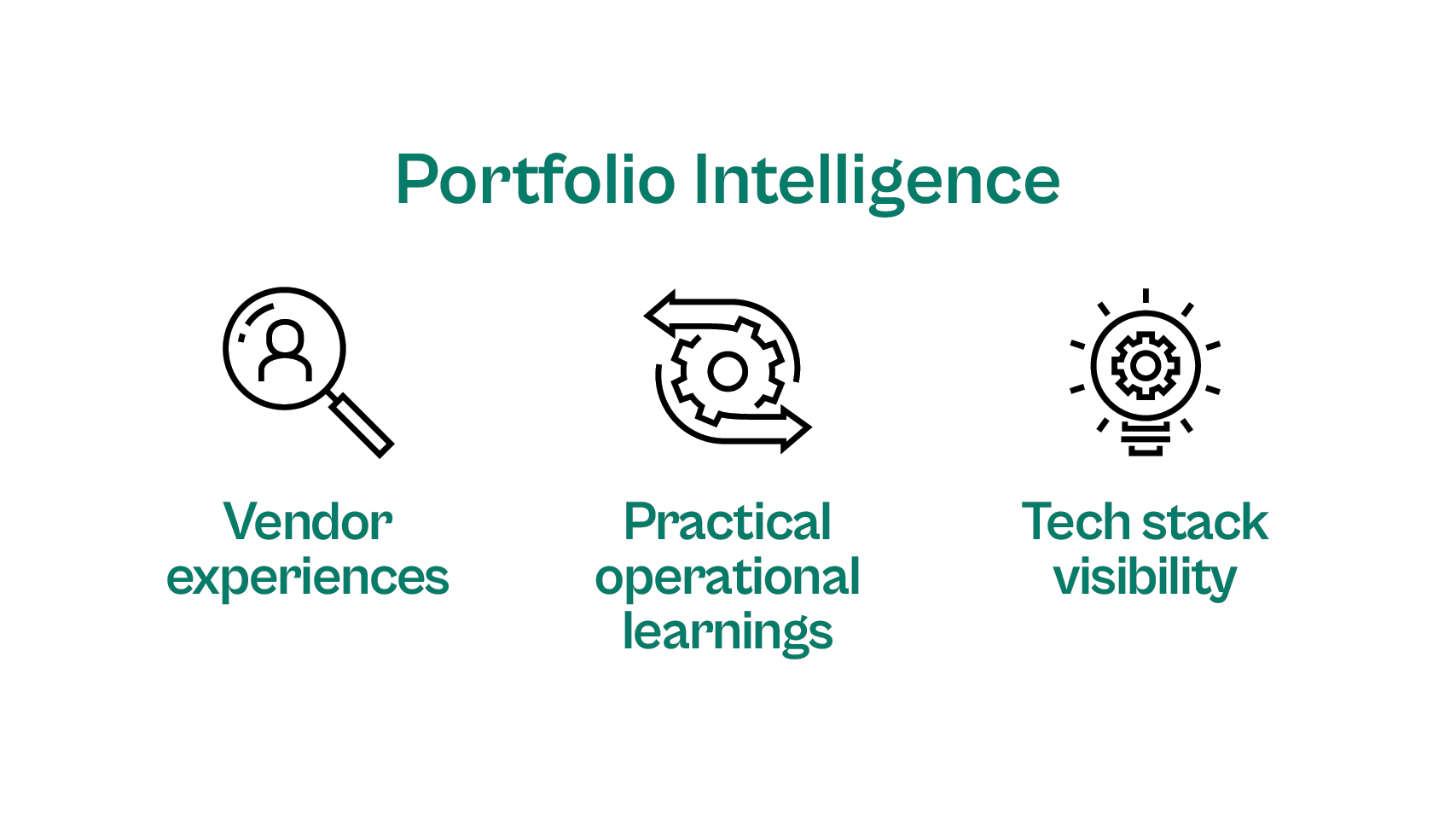
It brings together three essential layers:
- Vendor experiences
- Which vendors delivered?
- Which ones didn’t?
- What problems were solved (or created)?
- Tech stack visibility
- What do peer companies use for HR, finance, IT, RevOps?
- Which tools are rising in favor?
- Which ones are quietly being replaced?
- Practical operational learnings
- What onboarding mistakes should a new CFO avoid?
- Which workflows improved operational efficiency in similar companies?
- What everyday practices should be baked into early operations?
This isn’t about fancy data analytics, dashboards, or predictive analytics.
It’s about giving founders the valuable insights they need to make smarter decisions faster.
Why Portfolio Intelligence Is Becoming the Platform Advantage
Platform teams rarely get credit for the math behind a successful fund. While deal teams chase capital, founders chase traction, and boards chase milestones, platform leaders are the ones stitching together the operational context that keeps companies from making the same avoidable mistakes.
But the stakes have shifted. With tighter markets, shorter runways, and higher expectations from limited partners, the cost of a bad operational choice compounds faster than ever. A poor vendor fit bleeds time. A misguided tool implementation stalls momentum. A wrong early hire throws off execution. In a competitive landscape, even small detours can quickly erode fund-level performance.
This pressure is why industry leaders in PE firms are rethinking what drives real differentiation. It’s no longer about who has the best strategy deck or the biggest database of deal notes. It’s about who can turn the portfolio into a learning system, a shared operational network where companies benefit from each other’s experience, not just from quarterly meetings or scattered one-off intros.
Portfolio intelligence is one of the ways to unlock that shift.
It creates a connected ecosystem where founders don’t waste cycles evaluating the wrong tools, repeating vendor conversations, or re-running the same half-informed due diligence. Instead, they start from a position of clarity: they see which vendors have worked, which haven’t, and which tools scale best for companies that look like theirs.
And for platform teams, this visibility changes the job entirely.
They stop playing human search engines and start acting like strategic operators.
They gain insight into what’s happening across the portfolio level without relying on anecdotal updates or hallway conversations.
They finally have the pattern recognition needed for stronger investment and strategic decisions.
Portfolio intelligence also strengthens the fund’s negotiation position. When you can see where five companies are working with the same provider, you gain leverage on contract terms, pricing, consistency, and business continuity. When you can track how companies shift between tools, you can identify churn patterns early and the kind of risk signals that don’t show up in financial models or automation dashboards.
And for founders, the benefit is immediate:
- less time wasted,
- fewer missteps,
- better customer experience,
- more informed paths to operations stability.
If execution velocity is as important as deal flow, then portfolio intelligence becomes the multiplier that can improve outcomes across the board. It reduces noise, sharpens decision-making, and anchors every operator in the collective lessons of the portfolio, not just their own.
.jpg)
How Proven Supports Portfolio Intelligence
Proven isn’t trying to replace portfolio management tools or become another system for platform teams to maintain. It’s deliberately simple: a central place where founders can see which vendors and tools their peers are using, what worked, what didn’t, and what’s trending across the fund.
Think of it as operational truth serum, the real-world signal that cuts through marketing noise, scattered docs, and tribal memory.
Here’s how Proven actually supports portfolio intelligence in a way that matches the realities of business operations:
1. A real-time view of the portfolio’s vendor ecosystem
Proven provides a comprehensive database of vendors and tools used across the portfolio, not scraped from the internet, not curated by analysts, but contributed by the companies themselves.
Platform teams can see:
- who uses which vendor
- what problems they’re solving
- where multiple vendors are doing the same job
- which new solutions are rising across the market
This helps operators spot patterns and make data driven insights meaningful without spinning up BI dashboards or complex automation projects.
2. Peer reviews grounded in lived founder experience
When a founder writes a review in Proven, it’s not a fluffy testimonial. It’s real context: how the vendor performed, what onboarding felt like, where support excelled or broke down, and whether the tool actually delivered the promised value.
These insights help teams collaborate effectively, reduce costs, and sidestep mistakes that are invisible in sales calls and demos.
3. Tech stack visibility that reflects real operational maturity
Proven shows the tech stack of every company in the portfolio and ever-evolving usage that reflects actual adoption.
This helps founders understand:
- how tools change across stages
- which solutions work in their vertical
- where migrations and tool replacements are happening
- how their setup compares to peers
For operators, this becomes a powerful tool for risk assessment, optimizing workflows, and improving long-term success across companies.
4. Vendor trends and early signals you won’t find in sales decks
Because Proven aggregates usage across real portfolio companies, it naturally surfaces “rising stars” (vendors that are gaining traction) and early warning signs for tools that are starting to fall out of favor.
These signals help platform teams manage vendor relationships, inform investment in internal enablement, and identify places to dig deeper before small issues snowball into portfolio-wide operations friction.
5. A lightweight, low-lift tool designed for actual operator behavior
Proven doesn’t require lengthy onboarding sessions, data migration, or complex configuration. It works because it matches how operators and founders already communicate: simple, direct, and grounded in real work.
It supports:
- project management decisions
- contract clarity
- tighter business relationships
- more informed strategic decisions
- better cross-portfolio insights
All without becoming “yet another system” for platform teams to maintain.
6. Strengthening platform impact without overbuilding internal processes
Proven helps platform teams shift from reactive “ask me who to use” mode to proactive, portfolio-wide operational clarity. They become facilitators of shared intelligence rather than human routers of institutional memory.
And because the knowledge is democratized, not locked in inboxes or stored inside individual heads, decisions get faster and more grounded in what’s already proven to work.
Some Examples of Portfolio Intelligence in Action
Here’s what Proven helps execute in the real world:
- A CEO avoids a poorly rated agency because two portcos already documented their experience.
- A new CTO chooses a security tool in hours because three portcos are happily using it.
- A platform leader spots redundant software across five portcos and negotiates better contract terms to reduce costs.
- A CFO adopts the same billing system used by similar-stage companies, simplifying operations and financial workflows.
- A founder upgrades their analytics stack after seeing early-stage portcos migrate away from outdated options.
These may sound small, but they compound over time, driving better decisions, reducing friction, and streamlining processes across the business.
What Great Platform Teams Do Differently
Talk to any operator who has worked across multiple funds, and they’ll tell you the same thing: the gap between an average platform team and a great one isn’t the number of templates they build or the size of their network; it’s how effectively they turn shared experience into repeatable operational advantage.
Great platform teams treat portfolio intelligence not as a side project, but as a core operating principle. And they do a few things consistently that most teams overlook:
1. They make knowledge accessible, not ornamental
Average teams collect resources; great teams create systems that founders actually use. They avoid overproduced playbooks that age quickly and instead build lightweight, searchable hubs of information grounded in what’s working this quarter, not last year.
2. They reduce friction
Instead of pushing new frameworks, heavy docs, or overly engineered processes, elite platform leaders tailor their practices around how operators naturally behave. They choose tools that support real-time questions, informal learning, and quick pattern matching, the kind of insight that drives day-to-day performance and fewer mistakes.
3. They connect peers with similar challenges
A great platform team can spot when two founders are facing the same vendor issue, the same operational bottleneck, or the same scaling challenge before either one asks for help. They serve as signal routers, not librarians, enabling faster decision-making and better cross-company collaboration.
4. They treat vendor outcomes as portfolio data
The best teams understand that every vendor experience is a data point. They don’t rely on memory or one-off conversations; they build a scalable way to track patterns, identify red flags, and support companies in making more informed operational calls across the organization.
5. They know when to step in and when to get out of the way
Elite platform operators strike the balance between guidance and autonomy. They don’t hand companies rigid rules; they provide insights, context, and stories from across the industry so teams can make better strategic decisions without feeling micromanaged.
6. They turn recurring questions into repeatable systems
Every platform team hears the same questions:
- “Who do we use for sales training?”
- “Which finance system integrates best later?”
- “Has anyone tried this new onboarding vendor?”
Great teams don’t answer these one at a time. They build a portfolio-wide process that captures this institutional knowledge so the whole business benefits.
7. They avoid the trap of reactive support
Great platform leaders operate upstream. Instead of waiting for problems to escalate, they proactively identify risk patterns, business gaps, or recurring operational issues across the portfolio. This turns support from episodic firefighting into strategic, pattern-driven engagement.
8. They use tools that reflect how operators actually work
Instead of adopting complex systems, they favor lightweight platforms like Proven (something founders will actually use) because it gives them immediate, actionable clarity without slowing execution. It doesn’t overreach. It doesn’t pretend to manage deal flow or run investment operations. It simply surfaces the collective intelligence that already exists across the fund.
Conclusion:
The real lesson here is that portfolio intelligence isn’t a system, it’s a habit. A discipline. And a way of running a portfolio where every company benefits from the experience of the ones that came before it.
Older companies within the portfolio who are existing customers to the same vendors your newer companies need become a real gold mine for insights, do's and don'ts as well as purchasing leverage as information flows freely amongst them.
And once a portfolio starts operating with this level of shared visibility, everything changes. Vendor decisions get easier. Tech stacks get tighter. Onboarding gets faster. Founders feel supported. Platform teams stop playing air-traffic control and start doing the strategic work they were hired for.
But someone has to turn scattered operational intelligence into something everyone can actually use. That’s the work of a modern platform leader and that’s where Proven sits as a valuable tool for the operator.
It's the simplest, most practical way to make portfolio-wide intelligence visible in one place, so that founders can move faster and teams can focus on the high-leverage work that actually changes outcomes.
If you’re ready to give your companies that advantage (the kind they feel immediately, not in a Q4 report), start by surfacing what they already know.
Proven helps you do exactly that.
Next step: Take a closer look at how portfolio teams in both private equity firms and VC firms use Proven to share vendor experiences, tools, and operational patterns. Then decide whether it’s the right fit for your portfolio’s operating discipline.


Browse more topics from this article
Heading 1
Heading 2
Heading 3
Heading 4
Heading 5
Heading 6
Lorem ipsum dolor sit amet, consectetur adipiscing elit, sed do eiusmod tempor incididunt ut labore et dolore magna aliqua. Ut enim ad minim veniam, quis nostrud exercitation ullamco laboris nisi ut aliquip ex ea commodo consequat. Duis aute irure dolor in reprehenderit in voluptate velit esse cillum dolore eu fugiat nulla pariatur.
Block quote
Ordered list
- Item 1
- Item 2
- Item 3
Unordered list
- Item A
- Item B
- Item C
Bold text
Emphasis
Superscript
Subscript
Heading 1
Heading 2
Heading 3
Heading 4
Heading 5
Heading 6
Lorem ipsum dolor sit amet, consectetur adipiscing elit, sed do eiusmod tempor incididunt ut labore et dolore magna aliqua. Ut enim ad minim veniam, quis nostrud exercitation ullamco laboris nisi ut aliquip ex ea commodo consequat. Duis aute irure dolor in reprehenderit in voluptate velit esse cillum dolore eu fugiat nulla pariatur.
Block quote
Ordered list
- Item 1
- Item 2
- Item 3
Unordered list
- Item A
- Item B
- Item C
Bold text
Emphasis
Superscript
Subscript
Heading 1
Heading 2
Heading 3
Heading 4
Heading 5
Heading 6
Lorem ipsum dolor sit amet, consectetur adipiscing elit, sed do eiusmod tempor incididunt ut labore et dolore magna aliqua. Ut enim ad minim veniam, quis nostrud exercitation ullamco laboris nisi ut aliquip ex ea commodo consequat. Duis aute irure dolor in reprehenderit in voluptate velit esse cillum dolore eu fugiat nulla pariatur.
Block quote
Ordered list
- Item 1
- Item 2
- Item 3
Unordered list
- Item A
- Item B
- Item C
Bold text
Emphasis
Superscript
Subscript
Heading 1
Heading 2
Heading 3
Heading 4
Heading 5
Heading 6
Lorem ipsum dolor sit amet, consectetur adipiscing elit, sed do eiusmod tempor incididunt ut labore et dolore magna aliqua. Ut enim ad minim veniam, quis nostrud exercitation ullamco laboris nisi ut aliquip ex ea commodo consequat. Duis aute irure dolor in reprehenderit in voluptate velit esse cillum dolore eu fugiat nulla pariatur.
Block quote
Ordered list
- Item 1
- Item 2
- Item 3
Unordered list
- Item A
- Item B
- Item C
Bold text
Emphasis
Superscript
Subscript
Heading 1
Heading 2
Heading 3
Heading 4
Heading 5
Heading 6
Lorem ipsum dolor sit amet, consectetur adipiscing elit, sed do eiusmod tempor incididunt ut labore et dolore magna aliqua. Ut enim ad minim veniam, quis nostrud exercitation ullamco laboris nisi ut aliquip ex ea commodo consequat. Duis aute irure dolor in reprehenderit in voluptate velit esse cillum dolore eu fugiat nulla pariatur.
Block quote
Ordered list
- Item 1
- Item 2
- Item 3
Unordered list
- Item A
- Item B
- Item C
Bold text
Emphasis
Superscript
Subscript




.png)