
Data-Driven Banking: Using Insights to Strengthen SME Relationships

Data alone doesn’t strengthen SME relationships; insight does.
As small businesses engage across digital channels, banks have an opportunity to use analytics, transaction history, and behavioral signals to deliver more relevant advice, faster decisions, and better service.
This article explores how community and regional banks can use data responsibly to improve customer experience, manage risk, increase loyalty, and support SMEs with clarity without losing the human touch that defines relationship banking.

In small business banking, data has never been scarce. What’s been missing is the ability to turn that data into something genuinely useful for the people who need it most: relationship managers, branch teams, and the SME clients they support every day.
Across financial institutions, investment in digital technologies has accelerated. Banks collect transaction data, monitor account activity, and track behavior across digital channels like online banking, mobile platforms, and mobile banking apps. Yet for many banks, especially in sme banking, the insights stop at the dashboard.
The opportunity isn’t about acquiring more data but rather using data analytics to strengthen relationships, anticipate business needs, and deliver better decisions in the moments that matter.
Why Insight Matters More Than Information
For small and medium enterprises, banking decisions are rarely abstract.
They’re tied to payroll deadlines, inventory purchases, delayed invoices, or the need to manage credit risk during uncertain periods.
The SME sector operates with less margin for error than retail banking customers or larger corporations. A missed payment or slow loan approval can have immediate consequences for cash flow and confidence.
This is where insight becomes powerful. Patterns in transaction history, changes in account balances, or shifts in payment behavior can reveal early signals about a sme business and whether that’s an opportunity for growth or a looming challenge.
Used well, data supports smarter credit risk management, more relevant lending solutions, and proactive conversations that feel timely rather than reactive.
Closing the Gap Between Data and Action
Many banks have invested heavily in systems that improve internal operations, but fewer have translated those capabilities into front-line impact.
Dashboards and reports often live far from the people responsible for account management and client engagement. Relationship managers may see the numbers, but not always the story behind them.
Some advanced digital banks are addressing this by embedding insight directly into daily workflows.
Instead of adding more tools, they integrate digital solutions that surface relevant signals at the right time, thereby helping teams prioritize outreach, manage risk, and spot opportunities for new revenue streams.
This is what turns analytics into business value. We don't automate for its own sake; we seek clarity that helps people act with confidence.
Building Trust Through Transparency
As open banking and embedded finance models expand, transparency has become inseparable from trust.
Global institutions like the World Bank, the European Central Bank, and the SME Finance Forum consistently highlight that customer expectations are shifting.
SMEs want to understand how their data is used, how decisions are made, and how banking services actually support their goals. Banks that communicate clearly, explain credit processes, share insights, and consistently offer educational resources consistently see higher customer satisfaction and stronger customer loyalty.
This is how a bank can maintain trust and credibility by ensuring decision-making is clear and aligns with the client's actual experience.
From Data Points to Dialogue
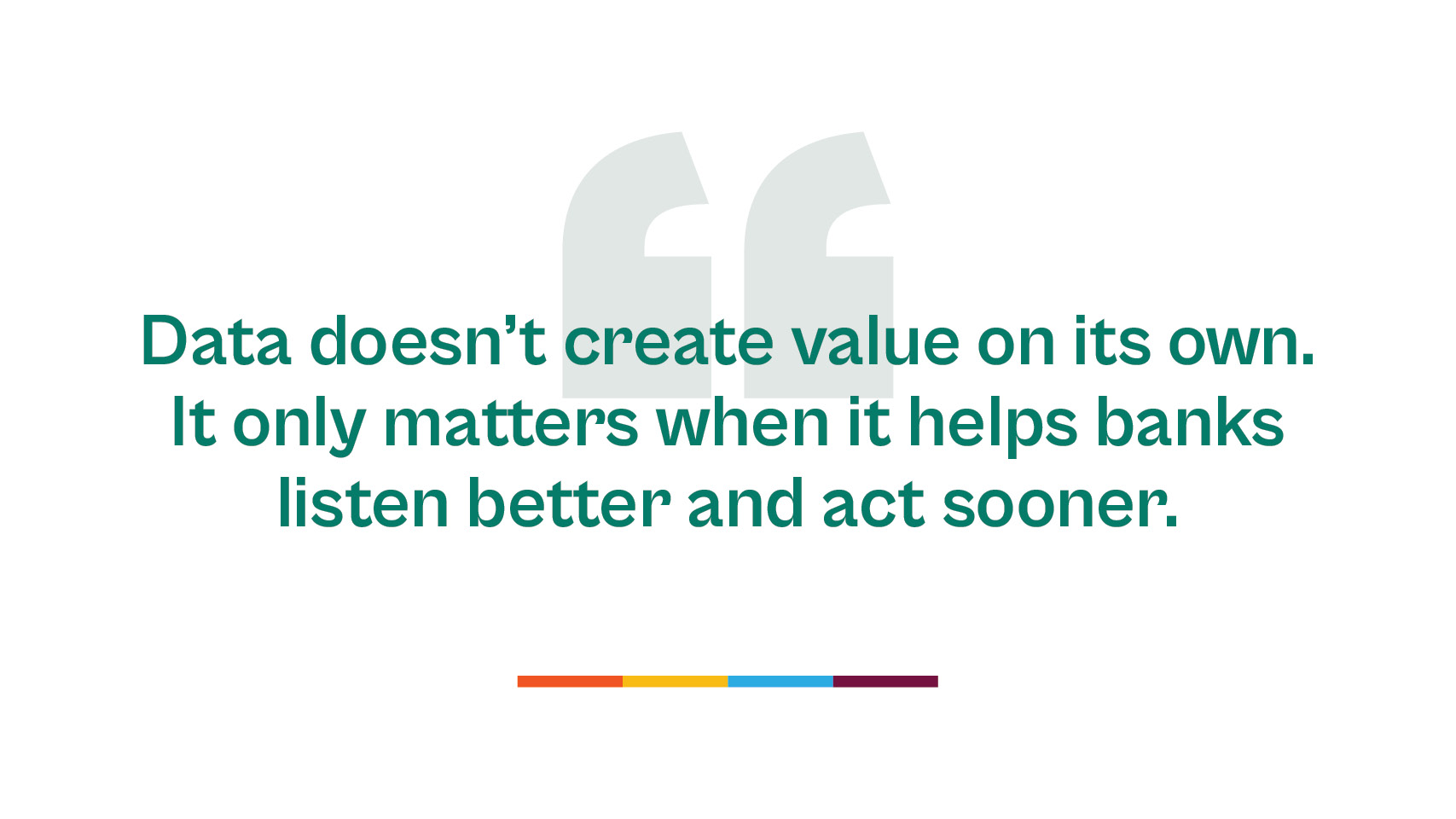
The most valuable use of data isn't to replace human interaction but to enhance it. When relationship managers have access to timely insights, their conversations become more impactful.
For example, a flagged drop in balances might prompt a discussion of short-term working capital. A steady rise in invoices could lead to invoice discounting or trade finance support.
Seasonal patterns can inform better risk management and tailored advice.
Some banks are even using automated meeting notes and CRM-integrated insights to reduce admin work, allowing teams to focus on listening rather than logging.
This shift transforms the customer experience from transactional to advisory, and that’s where loyalty is earned.
Customer Experience in SME Banking: Making Everyday Business Easier
From the perspective of the SME sector, banking is rarely about products in isolation. It’s about whether a bank makes it easier or harder to run a business.
Whether a business owner is navigating trade finance, applying for SME lending, or simply managing day-to-day cash flow, the quality of the experience matters as much as the outcome.
Today, small businesses interact with their bank across multiple touchpoints that include branches, advisors, and digital services. Yet too often, those experiences feel fragmented.
Clients are asked to repeat information, navigate complex banking solutions, or wait for answers that arrive too late to be useful.
Modern digital banking can make a real difference here when it is designed around how businesses actually operate, digital tools can simplify access to financial services, reduce friction, and support better decisions.
The goal isn’t automation for its own sake, but enabling businesses to focus on growth instead of administration.
The challenge for incumbent banks is that expectations have changed faster than systems. Many traditional banks still rely on service models built for a different era, where interactions were infrequent and largely transactional.
Failing to adapt risks losing relevance, not due to inferior products, but because the experience no longer aligns with the realities of modern SMEs.
Banks that invest in innovative solutions, especially those that connect services, insights, and support into a coherent experience, gain a lasting competitive advantage. From the customer’s point of view, the difference is simple: fewer obstacles, clearer guidance, and a sense that their bank understands the pressures they face.
When that happens, customer experience stops being a marketing concept and becomes a practical reason to stay.
Operational Efficiency Without Losing the Human Touch
There’s a persistent myth in banking that better service must cost more.
In reality, improved operational efficiency often makes better service possible.
By using digital self-service, mobile access, and smarter routing of inquiries, banks can reduce friction for sme customers while lowering the cost to serve.
At the same time, analytics-driven prioritization ensures that complex or high-impact cases receive human attention.
This balance enables banks to achieve both service quality and sustainable growth, especially when serving midsize businesses and medium enterprises across diverse SME markets.
Practical Banking Strategies for a Data-Driven SME Model
Becoming a data-driven bank doesn’t require a full systems overhaul. For most institutions, progress comes from small, deliberate shifts in how insight is used across teams, processes, and client interactions.
Here are a few banking strategies that translate data into real-world impact for SMEs:
1) Shift from reactive to signal-based outreach
Instead of waiting for SMEs to request support, banks can use transaction patterns, cash-flow changes, or invoice activity as early indicators. A sudden dip in balances or delayed payments can prompt proactive outreach before a problem escalates. This approach strengthens relationships while improving credit outcomes.
2) Equip relationship managers with context, not just dashboards
Front-line teams don't need additional reports; they need clearer signals. Concise insights, trend notifications, and basic client summaries enable relationship managers to have meaningful, well-informed conversations, all without increasing administrative workload.
3) Align lending decisions with behavioral insight
Data-driven lending enhances judgment rather than replacing it. By integrating transaction history with behavioral patterns, banks can make credit reviews more efficient, ease approval processes, and manage risk more effectively, particularly for expanding SMEs with unconventional profiles.
4) Design digital self-service around real business moments
Digital tools should map to how SMEs actually operate: invoicing, payroll, vendor payments, and forecasting. When online and mobile banking reflect daily workflows, adoption increases and support costs fall.
5) Measure success through relationship health
Beyond loan volume or product uptake, banks should track metrics such as engagement frequency, advisory touch points, and client retention. These metrics reflect both short-term revenue and long-term value creation.
Taken together, these strategies help banks move from data collection to data confidence-building SME relationships that are proactive, resilient, and scalable.
Curious how banks are putting these ideas into practice? See how Proven helps make SME support simpler and more connected.

What This Means for Strategy Leaders
For senior leaders, the implication is less about adopting new tools and more about setting clear priorities.
Data-driven banking only works when ownership is explicit, when insight is treated as a shared responsibility across relationship teams, lending, and operations, not just something confined to IT or analytics groups.
The real leadership challenge is alignment. Ensuring that incentives, processes, and decision-making frameworks reinforce better use of insight across the organization (from frontline conversations to credit approvals) is what separates incremental improvement from real change.
Few banks can manage this shift efficiently. Those that do create an environment where insight travels faster than hierarchy, decisions are informed rather than delayed, and teams stay focused on long-term client value rather than short-term transaction.
Conclusion
For small and medium enterprises, the difference between a good bank and a great one isn’t the number of products it offers. Rather, it’s how often the bank actually makes business easier.
In a world where expectations are shaped by digital platforms and real-time service, banks that stay relevant are the ones that understand their customers’ day-to-day pressures and remove friction where it counts.
Data, technology, and platforms matter only when they translate into clarity, timely support, and confidence for the businesses that rely on them.
The opportunity for banks today is to show up consistently in moments of growth, uncertainty, and decision-making as a partner that understands the reality of running a business.
When banking fits naturally into the rhythm of everyday work, loyalty follows. And that’s where lasting value is created for customers, communities, and the institutions that serve them.
See how Proven helps banks turn everyday insight into meaningful support for small businesses.


Browse more topics from this article
Heading 1
Heading 2
Heading 3
Heading 4
Heading 5
Heading 6
Lorem ipsum dolor sit amet, consectetur adipiscing elit, sed do eiusmod tempor incididunt ut labore et dolore magna aliqua. Ut enim ad minim veniam, quis nostrud exercitation ullamco laboris nisi ut aliquip ex ea commodo consequat. Duis aute irure dolor in reprehenderit in voluptate velit esse cillum dolore eu fugiat nulla pariatur.
Block quote
Ordered list
- Item 1
- Item 2
- Item 3
Unordered list
- Item A
- Item B
- Item C
Bold text
Emphasis
Superscript
Subscript
Heading 1
Heading 2
Heading 3
Heading 4
Heading 5
Heading 6
Lorem ipsum dolor sit amet, consectetur adipiscing elit, sed do eiusmod tempor incididunt ut labore et dolore magna aliqua. Ut enim ad minim veniam, quis nostrud exercitation ullamco laboris nisi ut aliquip ex ea commodo consequat. Duis aute irure dolor in reprehenderit in voluptate velit esse cillum dolore eu fugiat nulla pariatur.
Block quote
Ordered list
- Item 1
- Item 2
- Item 3
Unordered list
- Item A
- Item B
- Item C
Bold text
Emphasis
Superscript
Subscript
Heading 1
Heading 2
Heading 3
Heading 4
Heading 5
Heading 6
Lorem ipsum dolor sit amet, consectetur adipiscing elit, sed do eiusmod tempor incididunt ut labore et dolore magna aliqua. Ut enim ad minim veniam, quis nostrud exercitation ullamco laboris nisi ut aliquip ex ea commodo consequat. Duis aute irure dolor in reprehenderit in voluptate velit esse cillum dolore eu fugiat nulla pariatur.
Block quote
Ordered list
- Item 1
- Item 2
- Item 3
Unordered list
- Item A
- Item B
- Item C
Bold text
Emphasis
Superscript
Subscript
Heading 1
Heading 2
Heading 3
Heading 4
Heading 5
Heading 6
Lorem ipsum dolor sit amet, consectetur adipiscing elit, sed do eiusmod tempor incididunt ut labore et dolore magna aliqua. Ut enim ad minim veniam, quis nostrud exercitation ullamco laboris nisi ut aliquip ex ea commodo consequat. Duis aute irure dolor in reprehenderit in voluptate velit esse cillum dolore eu fugiat nulla pariatur.
Block quote
Ordered list
- Item 1
- Item 2
- Item 3
Unordered list
- Item A
- Item B
- Item C
Bold text
Emphasis
Superscript
Subscript
Heading 1
Heading 2
Heading 3
Heading 4
Heading 5
Heading 6
Lorem ipsum dolor sit amet, consectetur adipiscing elit, sed do eiusmod tempor incididunt ut labore et dolore magna aliqua. Ut enim ad minim veniam, quis nostrud exercitation ullamco laboris nisi ut aliquip ex ea commodo consequat. Duis aute irure dolor in reprehenderit in voluptate velit esse cillum dolore eu fugiat nulla pariatur.
Block quote
Ordered list
- Item 1
- Item 2
- Item 3
Unordered list
- Item A
- Item B
- Item C
Bold text
Emphasis
Superscript
Subscript





.png)


