
How VC Platform Teams Build Tech Stack Consistency Without Mandates

Every VC platform team lives with the same tension. Founders want autonomy to move fast, but portfolios perform better when portfolio companies don’t reinvent the same technology decisions in isolation. And yet, few things damage trust faster than suggesting a “standard” stack too early.
Founders push back. Small teams get defensive. Even well-intentioned guidance can start to feel like governance.
Experienced platform leaders know something important:
Tech stack consistency isn’t created through mandates. It’s created through visibility.
When founders have on-demand access to how peers made similar technology choices, what worked, what didn’t, and what trade-offs emerged, alignment forms naturally. No policy enforcement or forced adoption necessary. That empowers founders to make informed decisions shaped by real outcomes across the portfolio.
Many assume this level of visibility and alignment is only possible for large private equity firms, but we've written this for small VC platform teams and portfolio operators to show that any firm can reduce friction and fragmentation so that founders can make the right choices even under high pressure and time constraints without slowing execution.
A Different Lens on Why Choosing the Right Tech Stack Matters Early
In early-stage companies, tooling decisions often feel temporary. A quick CRM, a lightweight analytics tool, a few new tools added to keep things moving. When teams are small and speed matters, it’s reasonable to assume these choices can be revisited later.
What’s easy to miss is how quickly those early decisions harden. As a company grows, tools stop being conveniences and start becoming internal systems, the infrastructure that shapes workflows, reporting, and exposure to operational risk. What began as a stopgap quietly becomes embedded in daily execution.
A CRM chosen by two people in the first year can define decision-making three years later. A finance system selected under time pressure can restrict access to real-time data needed by investors, deal teams, and leadership. A data tool that works well at low volume may struggle to support future growth or seamless integrations as complexity increases.
This is why platform teams view the tech stack through a different lens than most founders. Tech stacks aren’t just collections of software; they determine how data flows through the organization, how teams collaborate, and how quickly the business can adapt its business model. Early alignment doesn’t mean over-engineering; it means choosing tools with enough foresight to avoid unnecessary rewrites later.
When the right foundation is in place, teams spend less time compensating for tooling gaps and more time executing. Workflows improve, friction decreases, and companies are better positioned to scale in a way that supports long-term outcomes and fund performance over time.
The Real Issue Isn’t Tool Choice, It’s Tool Accumulation
Most venture portfolios don’t struggle because founders choose the wrong tools. They struggle because tooling decisions accumulate faster than teams can step back and reassess them.
In early stages, it’s natural for small teams to adopt whatever tools solve the immediate problem. Over time, those choices stack up: overlapping products, existing tools layered on top of one another, and existing systems that were never designed to work together. Each decision made sense in isolation, but together they create friction.
From a platform perspective, this is where missed insights start to compound. When teams can’t easily see how tools are being used across portfolio companies, it becomes harder to identify patterns, flag red flags, or guide teams toward better technology choices. What could have been a shared learning moment turns into repeated experimentation.
This accumulation affects execution in subtle but meaningful ways. Teams spend time reconciling data across systems, building workarounds to connect tools that don’t work seamlessly, and revisiting decisions that were assumed to be temporary.
Over time, this slows operations, increases risk, and makes it harder to manage the stack as the business scales.
The issue isn’t autonomy, it’s visibility. Without a clear view of how tooling decisions play out across the portfolio, even well-run companies end up carrying unnecessary complexity forward.

Why Do Mandates Fail in Venture Portfolios?
Mandates assume a level of uniformity that rarely exists in venture portfolios. Even within the same fund, companies differ meaningfully by stage, business needs, team composition, and customer profile. Tools that work well for one startup can become friction for another, which is why technology choices are never created equal across the portfolio.
In practice, mandates fail less because founders resist guidance and more because mandates simplify decisions that are inherently nuanced. They tend to overlook stage-specific trade offs, such as speed versus scalability or flexibility versus structure. A tool optimized for efficiency at one stage may introduce unnecessary overhead at another.
Mandates also shift ownership away from the people responsible for making the systems work day to day. When teams feel detached from the decision, they compensate through workarounds, parallel tools, or deferred adoption.
Platform teams understand this tension well. The most effective ones don’t try to dictate outcomes or slow teams down. Instead, they focus on improving the quality of decisions founders make by adding context, surfacing patterns, and making trade-offs clearer before choices become costly to unwind.

A platform team once noticed the same question coming up across three different companies: Which CRM should we start with? Each founder was asking independently, each for reasonable reasons, and each at a different stage of growth.
Individually, the answers varied. One company needed speed and simplicity. Another needed better reporting for investors. A third had already outgrown their first tool and was feeling the pain of migration. None of these contexts were wrong but they weren’t visible to one another.
Once the platform team stepped back and compared outcomes across those companies, patterns emerged. One tool worked well early but consistently required replacement within a year. Another scaled easily but slowed teams down at the seed stage. The insight wasn’t “use this CRM.” It was when each option made sense and when it didn’t.
That shift (from recommending tools to sharing context) changed how founders approached the decision. Instead of asking for the right answer, they asked better questions. And the platform team stopped answering the same question over and over.
What Strong VC Platform Teams Do Instead
The most effective VC platform teams don’t try to standardize tools. They standardize learning.
Instead of telling founders what to use, they focus on making the portfolio’s collective experience visible and usable. This starts with tech stack visibility, not as a static inventory, but as living context. Platform teams invest in understanding which tools companies are actually using, why those tools were chosen, and how they performed once embedded in day-to-day operations.
Over time, this visibility reveals portfolio-level patterns that individual companies can’t see on their own. Certain tools consistently scale well across stages. Others perform adequately early but create friction later. Some vendors look strong on paper but struggle in real implementations. These patterns matter far more than opinions or vendor reputation, because they’re grounded in real outcomes.
Strong platform teams also frame guidance through the lens of stage fit. Rather than promoting a “best-in-class” stack, they help founders understand which stage-appropriate tools worked for companies facing similar constraints, i.e, team size, customer profile, regulatory exposure, or growth velocity. This keeps advice practical and relevant, not aspirational.
Finally, they turn recurring questions into repeatable operating systems. When founders repeatedly ask about CRMs, analytics tools, or finance systems, the answer isn’t another one-off conversation. It’s a shared, evolving body of insight that captures what the portfolio has already learned. This reduces cognitive load for founders and allows platform teams to spend less time re-answering the same questions and more time spotting new risks and opportunities.
The result is a better starting point. Founders retain ownership of decisions, but they make them with clearer context, fewer blind spots, and a stronger understanding of the trade-offs involved.
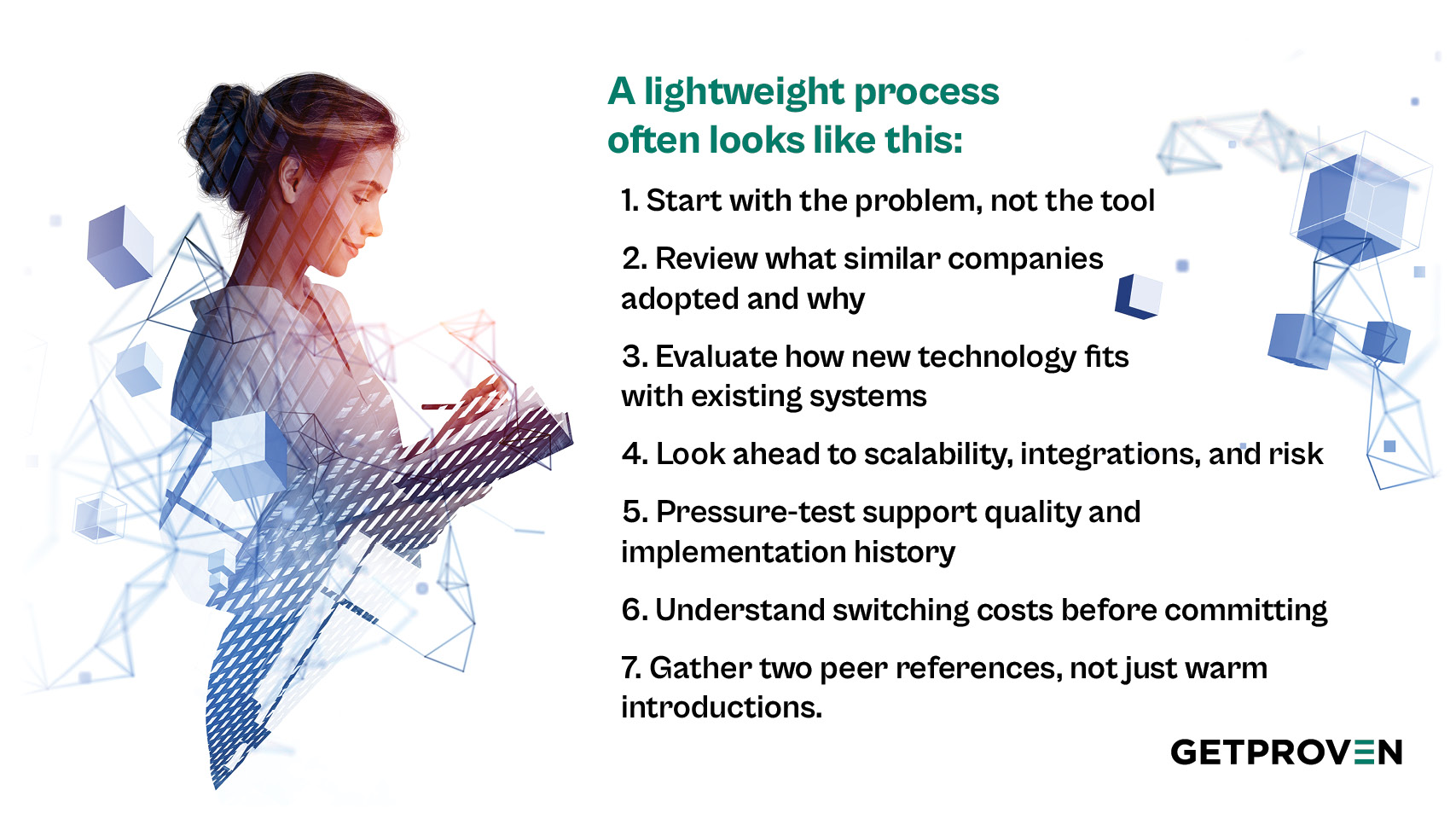
A Practical Framework for Guiding Tech Stack Decisions
Platform teams need frameworks that respect speed but also acknowledge that early decisions compound. The goal isn’t to slow founders down; it’s to help them avoid decisions that feel fast now and expensive later.
Here’s how strong platform teams apply this framework in practice.
Start with the problem, not the tool
Most poor tech stack decisions start with a tool category (“We need a CRM”) instead of a problem definition (“We need a reliable way to forecast pipeline by segment”). When teams skip this step, vendors end up defining the problem for them, usually in a way that favors their product.
Platform teams encourage founders to articulate:
- What’s breaking today
- What outcome needs to improve
- What would change if this problem were solved
When the problem is clear, evaluation becomes grounded. When it isn’t, every demo sounds compelling and decision-making drifts.
Review what similar companies adopted and why
Looking at what peers use isn’t about copying decisions; it’s about understanding context. Help founders see why similar companies chose certain tools, what constraints they were under, and what trade-offs they accepted.
This perspective often reveals patterns:
- Tools that work well early but are consistently replaced
- Solutions that feel heavy upfront but scale cleanly
- Decisions that founders later regret
Seeing those patterns helps teams start from a smarter baseline instead of a blank slate.
Evaluate how new technology fits with existing systems
New tools rarely live in isolation. They connect to existing systems, data sources, and workflows, or they create manual work when they don’t.
The platform leader should push founders to ask:
- What systems will this tool touch on day one?
- Where will data flow break or duplicate?
- Who owns integration when something changes?
This step surfaces hidden complexity early, when it’s still cheap to adjust.
Look ahead to scalability, integrations, and risk
Early-stage tools are often chosen for speed, but you need to look one or two stages ahead. Don't over-engineer, but avoid obvious dead ends.
Questions that matter here:
- What happens when usage doubles?
- Does the vendor support common integrations we’ll need later?
- Are there known limitations that trigger migrations at scale?
This isn’t about buying enterprise software early; it’s about avoiding tools that cap growth unexpectedly.
Pressure-test support quality and implementation history
Sales conversations are polished. Implementation reality is not.
Consistently encourage founders to dig into:
- Who actually handles onboarding
- How long it took other teams to see value
- What support looks like after the sale
- Where implementations went sideways
This is often where the biggest differences between vendors emerge and where demos are least useful.
Understand switching costs before committing
Early tools feel temporary until they’re deeply embedded. That's why it's important to help founders understand:
- How hard it would be to migrate later
- What data portability looks like
- Which workflows become sticky quickly
Knowing the exit path upfront changes how teams assess risk and commitment.
Gather two peer references, not just warm introductions
Vendor-provided references are useful, but incomplete. Encourage founders to speak with peers who weren’t handpicked by sales.
Two honest conversations with operators who lived through the decision will surface:
- What broke
- What surprised them
- What they’d do differently
That insight is often more valuable than any feature comparison.
This approach supports smarter decisions without adding bureaucracy.
It respects the realities of small teams, fast timelines, and evolving needs while reducing the likelihood that founders will outgrow their tools too quickly or repeat mistakes others already made.
For platform teams, it creates a shared decision language. For founders, it provides clarity without control. And for the portfolio, it turns isolated decisions into cumulative learning.
What Does A Healthy Tech Stack Look Like?
- Fewer migrations and cleaner handoffs
- Faster onboarding for new hires
- Better real time visibility into performance
- Improved data quality for capital markets conversations
- Clearer insight into key areas of execution
- Lower operational risk as the company scales
Consistency without mandates improves speed, reduces waste, and supports innovation.
How Proven Supports Alignment Without Control
Most platform teams don’t struggle with what guidance to give; they struggle with how to share it without becoming a bottleneck. The intent is almost always the same: help founders avoid repeating decisions the portfolio has already lived through. The challenge is doing that in a way that preserves speed and ownership.
This is where Proven fits naturally into the workflow. It doesn’t enforce governance policies or attempt to replace internal tools teams already rely on. Instead, it provides on demand access to shared portfolio insight, making prior experience visible at the moment decisions are being made.
In practice, this means platform teams and founders can see how technology decisions actually played out across companies, not just how they were pitched. Teams can compare stacks across stages, notice patterns around new technology adoption, and understand which key features mattered in real operating environments. That context helps founders evaluate trade-offs earlier, before tools are embedded and harder to change.
The value isn’t in prescribing answers. It’s in reducing blind spots. When founders can see what peers tried, where things broke, and what scaled well, decisions become easier. Platform teams spend less time reacting to issues after the fact and more time supporting better decisions upstream.
By making portfolio learning accessible without adding process, Proven helps platform leaders do what they’re already trying to do: support autonomy with context, and alignment without control.
Conclusion:
The most valuable work platform teams do rarely shows up as a mandate, a policy, or a tool rollout. It shows up later when a founder avoids a migration, when a team scales without rewriting systems, and when a decision feels obvious instead of risky.
That outcome doesn’t come from controlling choices. It comes from making experience visible.
Surfacing what the entire portcos already know, and their tech stack consistency, private equity and venture capital platform leaders alike give their founders and management teams a unique advantage through the power of shared data. All while preserving autonomy where it is most needed.
Over time, this approach leads to fewer repeated mistakes and reactive cleanups, as well as more thoughtful decisions made earlier, when changes are still cost-effective.
Your takeaway: don’t start by standardizing tools. Start by standardizing access to learning. Make it easier for founders to see what’s already been tried across the portfolio, and let alignment emerge from context rather than control. Proven exists to support that exact shift. We give you a simple way to share insight without slowing anyone down. Learn more here.


Browse more topics from this article
Heading 1
Heading 2
Heading 3
Heading 4
Heading 5
Heading 6
Lorem ipsum dolor sit amet, consectetur adipiscing elit, sed do eiusmod tempor incididunt ut labore et dolore magna aliqua. Ut enim ad minim veniam, quis nostrud exercitation ullamco laboris nisi ut aliquip ex ea commodo consequat. Duis aute irure dolor in reprehenderit in voluptate velit esse cillum dolore eu fugiat nulla pariatur.
Block quote
Ordered list
- Item 1
- Item 2
- Item 3
Unordered list
- Item A
- Item B
- Item C
Bold text
Emphasis
Superscript
Subscript
Heading 1
Heading 2
Heading 3
Heading 4
Heading 5
Heading 6
Lorem ipsum dolor sit amet, consectetur adipiscing elit, sed do eiusmod tempor incididunt ut labore et dolore magna aliqua. Ut enim ad minim veniam, quis nostrud exercitation ullamco laboris nisi ut aliquip ex ea commodo consequat. Duis aute irure dolor in reprehenderit in voluptate velit esse cillum dolore eu fugiat nulla pariatur.
Block quote
Ordered list
- Item 1
- Item 2
- Item 3
Unordered list
- Item A
- Item B
- Item C
Bold text
Emphasis
Superscript
Subscript
Heading 1
Heading 2
Heading 3
Heading 4
Heading 5
Heading 6
Lorem ipsum dolor sit amet, consectetur adipiscing elit, sed do eiusmod tempor incididunt ut labore et dolore magna aliqua. Ut enim ad minim veniam, quis nostrud exercitation ullamco laboris nisi ut aliquip ex ea commodo consequat. Duis aute irure dolor in reprehenderit in voluptate velit esse cillum dolore eu fugiat nulla pariatur.
Block quote
Ordered list
- Item 1
- Item 2
- Item 3
Unordered list
- Item A
- Item B
- Item C
Bold text
Emphasis
Superscript
Subscript
Heading 1
Heading 2
Heading 3
Heading 4
Heading 5
Heading 6
Lorem ipsum dolor sit amet, consectetur adipiscing elit, sed do eiusmod tempor incididunt ut labore et dolore magna aliqua. Ut enim ad minim veniam, quis nostrud exercitation ullamco laboris nisi ut aliquip ex ea commodo consequat. Duis aute irure dolor in reprehenderit in voluptate velit esse cillum dolore eu fugiat nulla pariatur.
Block quote
Ordered list
- Item 1
- Item 2
- Item 3
Unordered list
- Item A
- Item B
- Item C
Bold text
Emphasis
Superscript
Subscript
Heading 1
Heading 2
Heading 3
Heading 4
Heading 5
Heading 6
Lorem ipsum dolor sit amet, consectetur adipiscing elit, sed do eiusmod tempor incididunt ut labore et dolore magna aliqua. Ut enim ad minim veniam, quis nostrud exercitation ullamco laboris nisi ut aliquip ex ea commodo consequat. Duis aute irure dolor in reprehenderit in voluptate velit esse cillum dolore eu fugiat nulla pariatur.
Block quote
Ordered list
- Item 1
- Item 2
- Item 3
Unordered list
- Item A
- Item B
- Item C
Bold text
Emphasis
Superscript
Subscript




.png)


