
How We Score AI Agent Readiness Across SaaS Companies
At A Glance
AI agents are beginning to influence how software vendors are discovered, evaluated, and compared. This article explains how Proven scores AI agent readiness across SaaS companies using a proprietary framework built around crawlability, API readiness, pricing clarity, structured data, and agent ecosystem maturity, and why these standards may become increasingly important as AI-driven procurement evolves.

The software discovery process is beginning to change, and in 2026, teams are rethinking how they pick and purchase their tech stack.
For years, SaaS vendors primarily optimized their digital presence for humans and traditional search behavior. Companies invested heavily in branding, search engines, conversion funnels, and organic traffic strategies designed to attract buyers through manual research and evaluation.
That model is evolving as AI agents become increasingly capable of researching vendors, comparing platforms, interpreting pricing structures, reviewing integrations, and recommending solutions faster than a team would on their own. And all this happens before the buyer ever speaks with sales.
As this shift accelerates, something else is starting to matter: a vendor's ability to be AI-friendly. How does a modern software company measure its AI-gent readiness?
At Proven, we've built a scoring framework designed to evaluate how easy it is for intelligent systems to find, parse, understand, and integrate with SaaS vendors across the modern software ecosystem.
In this article, we explain the methodology behind our rankings, the scoring criteria we use, and why discoverability standards may become increasingly important as businesses continue implementing AI agents across operational environments.
If you want a broader introduction to what makes a company agent-ready, we explored that topic in our foundational guide on Agent-Friendly Companies and how software vendors can prepare for AI-driven evaluation.
Why AI Agent Readiness Matters
Almost all software companies established a decade ago or earlier were not originally designed for machine-driven evaluation.
Their websites were built for visual browsing. Their onboarding flows assumed manual interaction. Their pricing pages often required sales conversations. Documentation was written primarily for developers and technical teams rather than autonomous systems attempting to evaluate capabilities programmatically.
As a result, many platforms still create unnecessary complexity for intelligent evaluation systems.
This creates an important challenge for the future of software procurement.
As organizations continue deploying agents across procurement, research, operations, support, analytics, and workflow automation environments, vendors increasingly need to support both machine-readability and human usability.
This shift is not about replacing humans; rather, it reflects a growing reliance on automation to reduce friction during software evaluation. Intelligent systems can accelerate time spent researching vendors, summarize large volumes of information, analyze compatibility requirements, and identify potential implementation issues long before a formal procurement process begins.
That significantly changes how platforms compete. In many cases, software discoverability may increasingly depend on whether agents discover the right information quickly and reliably.
What Is AI Agent Readiness?
AI agent readiness refers to how accessible, interpretable, and usable a software vendor is for autonomous evaluation systems. This includes far more than API availability.
Modern evaluation systems analyze websites, documentation, integration standards, pricing transparency, developer ecosystems, trust signals, structured references, and interoperability layers to determine whether a platform can support automated evaluation and orchestration.
An effective readiness assessment therefore, examines whether intelligent systems can:
- Access a vendor’s public resources
- Interpret machine-readable information
- Understand pricing structures
- Review API accessibility
- Analyze documentation quality
- Assess integration support
- Evaluate operational reliability
- Interact with developer ecosystems
These signals collectively shape an organization’s agent readiness score.
How Proven Measures Agent Readiness
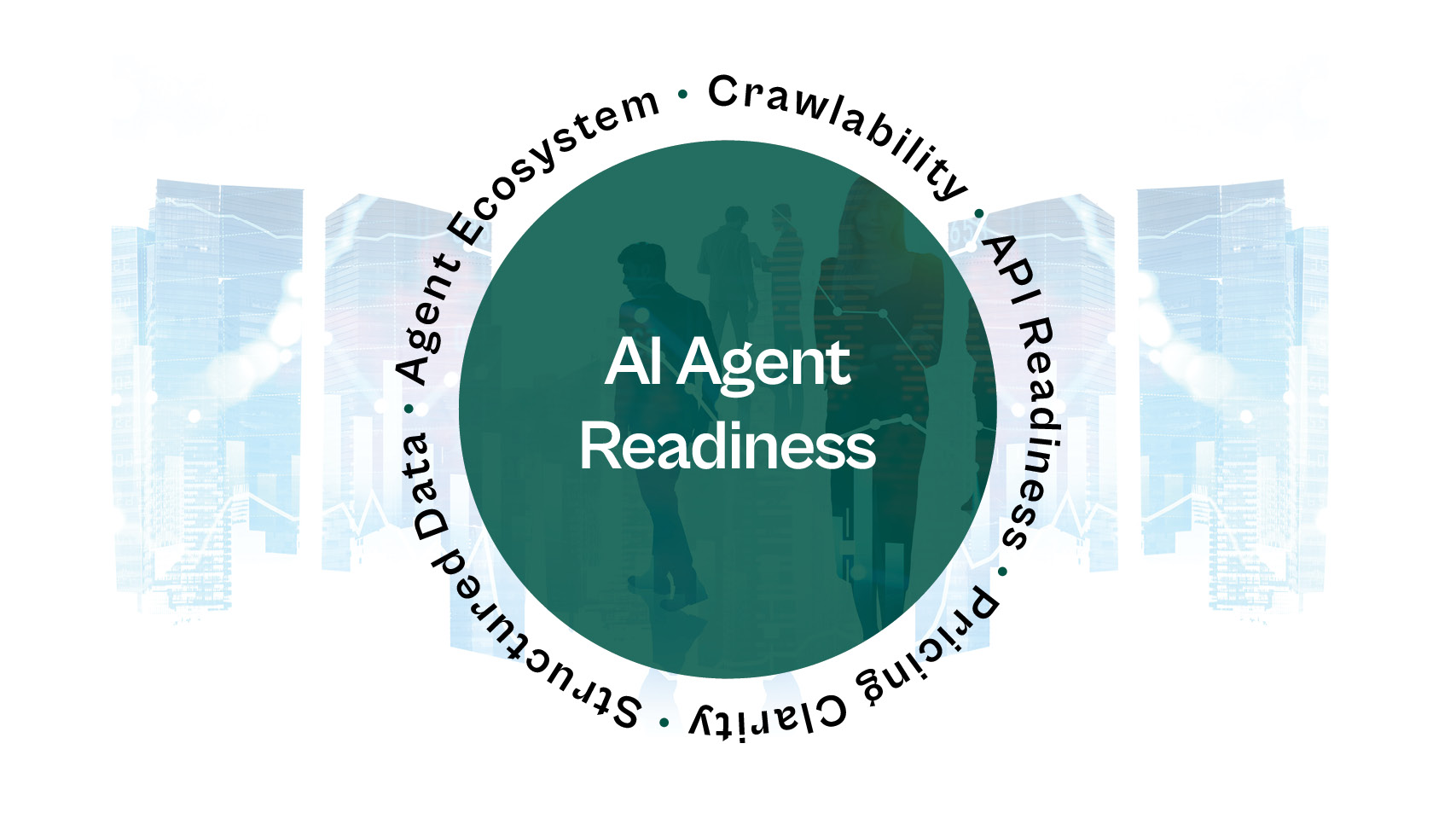
Our methodology evaluates SaaS vendors across five primary dimensions.
Each dimension reflects a different aspect of discoverability, interoperability, and operational accessibility for intelligent systems.
Scores are calculated out of 100 and translated into a letter-grade system ranging from A+ to F.
Rather than measuring marketing quality alone, the framework focuses on whether intelligent systems can evaluate and utilize a platform efficiently without excessive manual intervention.
There's an important distinction to note here. A visually polished website does not necessarily mean an intelligent system can interpret pricing, authenticate against APIs, navigate developer resources, or understand implementation requirements.
The framework, therefore, prioritizes operational accessibility over surface-level presentation.
To see how software vendors currently perform across crawlability, API readiness, pricing clarity, structured discoverability, and ecosystem maturity, explore Proven’s live agent readiness rankings.
View the current rankings →Here
I. Crawlability And Accessibility
The first category assesses whether intelligent systems can reliably access and interpret a platform.
This may sound obvious and simplistic, but it is one of the most important layers of agent readiness.
Before an intelligent system can compare pricing, review APIs, evaluate integrations, or analyze documentation, it first needs consistent access to the underlying information. In many cases, that access is more fragile than companies realize.
A growing number of software vendors unintentionally make automated evaluation difficult through overly aggressive crawler protections, JavaScript-heavy rendering environments, fragmented site structures, incomplete indexing standards, or restrictive bot policies that were originally designed to mitigate scraping and malicious traffic.
Those decisions are often reasonable from a security or infrastructure perspective. The challenge is that they can also limit legitimate machine interpretation.
An intelligent system attempting to evaluate a vendor may encounter blocked crawlers, inaccessible documentation paths, incomplete metadata, or dynamically rendered content that cannot easily be parsed programmatically. In those environments, even strong platforms become harder to evaluate reliably.
Our framework therefore looks for foundational discoverability signals that improve accessibility for machine-driven evaluation systems, including:
- Public /llms.txt availability
- Accessible /robots.txt configurations
- Open sitemap.xml structures
- Visibility for GPTBot and ClaudeBot
These signals help determine whether intelligent systems can discover, navigate, and interpret a platform consistently.
The strategic implications are significant.
Historically, crawlability primarily affected how websites appeared in search engines. Increasingly, it may also influence whether intelligent systems can evaluate operational capabilities, compare vendors, interpret implementation requirements, and surface platforms during AI-assisted procurement workflows.
In other words, if intelligent systems cannot reliably access critical information, they cannot confidently evaluate a vendor. That doesn't necessarily mean the product lacks quality. It simply means the surrounding environment creates friction for autonomous interpretation.
As software discovery becomes more machine-assisted, accessibility may increasingly shape which vendors are visible during the earliest stages of evaluation.
II. API Readiness And Developer Accessibility
The second dimension focuses on how accessible and interpretable a vendor’s technical infrastructure is for external systems.
This category goes far beyond simply having an API. Many SaaS companies technically expose APIs, but still create substantial friction for automated evaluation and integration. Documentation may be incomplete, authentication flows may be difficult to interpret programmatically, schemas may lack consistency, or implementation guidance may depend heavily on manual onboarding.
For intelligent systems attempting to autonomously evaluate a platform, those gaps matter.
An AI-driven procurement workflow does not interact with software the same way a human buyer does. It cannot rely on intuition or assumptions. Instead, it depends on structured references, predictable interfaces, machine-readable schemas, and accessible developer resources that clearly explain how a system functions.
This becomes especially important as organizations expand AI initiatives across internal operations, analytics, orchestration layers, and workflow automation environments.
The easier it is for systems to understand how a platform authenticates, exchanges data, handles integrations, and exposes functionality, the easier it becomes to evaluate implementation complexity, operational compatibility, and long-term scalability.
Our framework therefore evaluates several signals associated with developer accessibility and integration readiness, including:
- Hosted OpenAPI or Swagger specifications
- Public API documentation
- Clear api reference structures
- Docs subdomains
- GitHub developer resources
These signals help determine whether external systems can understand and interact with a platform efficiently.
Companies like Vercel, Attio, and Fall often perform well because their developer ecoystems prioritixe consistency, transparency and operational clarity.
Their documentation is structured predictably. Their APIs are extensively documented. Their implementation flows are easier to interpret programmatically. Their ecosystems reduce ambiguity.
That accessibility creates practical advantages. Intelligent systems can evaluate capabilities more reliably, compare integration requirements more efficiently, and assess implementation feasibility with less manual intervention.
Over time, those characteristics may become increasingly important as businesses continue implementing AI tools across procurement, operations, infrastructure management, and software orchestration workflows.
In many ways, API readiness is becoming a form of operational discoverability.
The vendors that expose clear interfaces and structured developer ecosystems are often the easiest for intelligent systems to understand, evaluate, and integrate into larger automation environments.
Some vendors are already building highly accessible ecosystems for intelligent evaluation and interoperability. Explore which software companies currently rank highest across API readiness, discoverability, and agent accessibility.
See the top-ranked agent-ready vendors →Here
III. Pricing Clarity And Operational Transparency
One of the most underestimated barriers to AI-driven vendor evaluation is pricing opacity.
Many SaaS companies still rely on procurement models built around gated sales conversations, customized quotes, or pricing structures that require direct interaction before buyers can understand implementation costs.
That approach has historically been common in enterprise software. The challenge is that intelligent systems cannot evaluate ambiguity particularly well.
An autonomous evaluation environment attempting to compare vendors programmatically needs structured access to operational details such as pricing tiers, usage limits, implementation requirements, onboarding expectations, support structures, and packaging models. When this information is hidden behind sales workflows or fragmented across multiple pages, evaluation becomes significantly more difficult.
This is especially important because AI-driven procurement systems are fundamentally different from traditional buyer journeys.
Humans can infer meaning from vague messaging, request clarification during calls, or tolerate incomplete information during early research stages. Intelligent systems operate differently. They depend on accessible and interpretable references that reduce uncertainty during automated comparison processes.
Our methodology therefore evaluates several signals associated with pricing accessibility and operational transparency, including:
- Pricing transparency
- Machine-readable pricing structures
- Accessible plan comparisons
- Public implementation information
- Visible return policies where relevant
These elements influence whether intelligent systems can compare vendors confidently and consistently.
The issue extends beyond pricing alone.
Operational transparency increasingly shapes how intelligent systems evaluate implementation complexity, long-term scalability, integration effort, and potential procurement friction. A vendor may offer strong capabilities, but if critical information remains inaccessible during early evaluation, autonomous systems may struggle to assess the platform reliably. This creates a broader strategic implication.
Historically, pricing pages were designed primarily to optimize conversion flows and lead generation. Increasingly, they may also function as machine-readable operational references that influence whether platforms are surfaced, compared, and evaluated during AI-assisted procurement workflows.
In environments where intelligent systems help filter and shortlist vendors, accessibility becomes a competitive factor. The vendors that expose operational clarity early will reduce friction not only for humans, but also for the systems evaluating them programmatically.
IV. Structured Data and Machine Readability
The fourth category evaluates structured data and machine-readable accessibility.
Modern software ecosystems increasingly depend on systems being able to interpret information programmatically.
This includes schema markup, JSON-LD references, metadata structures, and content formatting that helps intelligent systems understand websites more effectively.
Many vendors still overlook this layer entirely.
Yet these standards may play a growing role as agentic AI systems continue evolving beyond traditional search environments.
Historically, platforms optimized for Google indexing and human browsing behavior. Future discoverability standards may increasingly prioritize whether systems can interpret relationships, services, infrastructure layers, pricing models, and operational capabilities automatically.
This is one reason data readiness is becoming more important across modern SaaS environments. Poor data quality creates friction not only for analytics and automation, but also for intelligent vendor evaluation.
V. Agent Ecosystem Maturity
The final dimension evaluates how well a platform supports the broader ecosystem surrounding intelligent automation.
This is often where the gap between traditional SaaS infrastructure and genuinely agent-ready environments becomes most visible. Many software companies now expose APIs, but far fewer have developed ecosystems designed to support interoperable automation across increasingly complex orchestration environments.
As organizations continue integrating intelligent systems into operations, analytics, procurement, customer workflows, infrastructure management, and software coordination layers, agents rarely operate in isolation. They increasingly depend on interconnected environments where systems exchange context, trigger workflows, access external services, and coordinate actions programmatically.
In these environments, ecosystem maturity becomes a significant operational advantage.
Our framework therefore evaluates whether vendors support the surrounding infrastructure that makes intelligent interoperability more practical and scalable. This includes signals such as:
- MCP server environments
- Official SDKs
- Webhook support
- Context7 indexing
- LangChain integrations
- LlamaIndex integrations
- API-key authentication standards
These signals help indicate whether platforms are designed to participate effectively within modern automation ecosystems.
For example, webhook support may allow external systems to react dynamically to workflow events in real time. SDKs can reduce implementation friction across development environments. Integration support for orchestration frameworks such as LangChain or LlamaIndex may improve how systems exchange context and coordinate multi-step tasks.
Even authentication approaches matter.
Platforms that support accessible API-key standards are often easier for autonomous systems to integrate with programmatically than environments dependent entirely on complex browser-based authorization flows.
Importantly, this category is not simply measuring how many integrations a vendor advertises.
It evaluates whether a platform appears structurally prepared for environments where intelligent systems coordinate actions across distributed infrastructure.
That preparation increasingly influences scalability.
As autonomous systems become more capable, vendors with mature integration ecosystems may create substantial operational advantages by reducing orchestration friction, simplifying implementation pathways, and improving interoperability across services.
In many ways, agent ecosystem maturity reflects how prepared a platform is for a future where software systems continuously interact, exchange information, and coordinate workflows with minimal human intervention.
Why Some Companies Score Higher Than Others
The highest-performing vendors typically share one defining characteristic: they reduce friction.
Their documentation is accessible, APIs are structured consistently, pricing models are easier to interpret, integration ecosystems are mature, and trust signals are visible. But more importantly, intelligent systems can evaluate their capabilities without requiring excessive human interpretation.
That accessibility becomes increasingly valuable as businesses continue integrating AI tools into procurement, analytics, operations, workflow automation, and vendor evaluation environments.
Interestingly, some of the most recognizable software brands do not currently score particularly well across agent readiness dimensions.
That is not necessarily because their products are weak. In many cases, it reflects the era in which those platforms were designed.
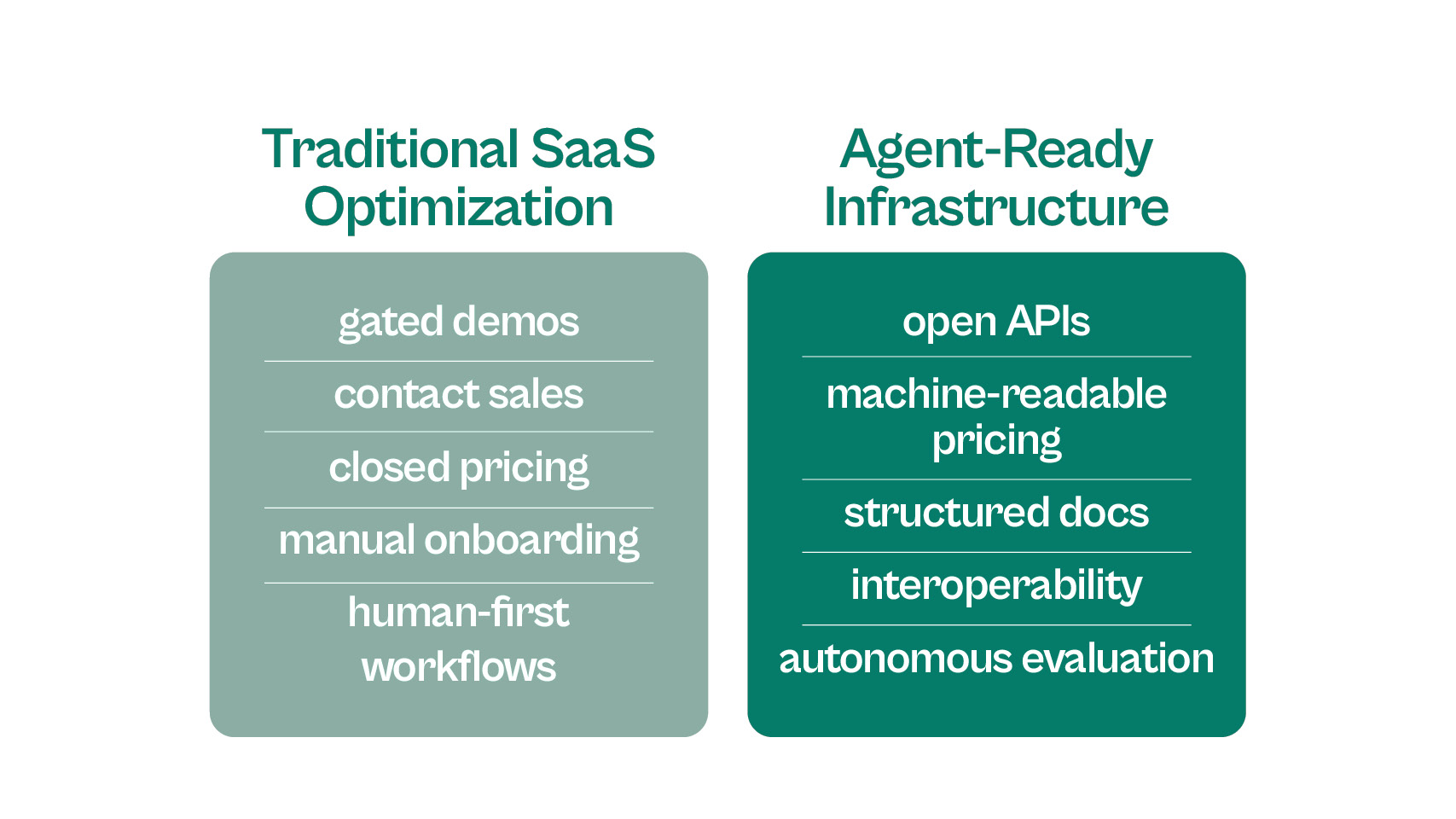
A large number of established SaaS companies built highly effective growth strategies around traditional buyer experiences: gated demos, sales-led onboarding, closed pricing structures, controlled procurement funnels, and documentation ecosystems optimized primarily for human navigation.
For years, that approach worked extremely well.
The challenge is that software discovery is beginning to evolve toward environments where intelligent systems increasingly participate in vendor research, evaluation, comparison, and orchestration.
In these new environments, some of the same structures that historically optimized enterprise sales can unintentionally create friction for autonomous evaluation systems.
Aggressive crawler restrictions, fragmented documentation, inaccessible pricing structures, browser-dependent workflows, or opaque implementation requirements may all reduce how effectively intelligent systems can interpret a platform programmatically.
This is one reason why we're starting to see emerging vendors sometimes outperform larger incumbents in agent discoverability rankings.
Smaller or newer platforms are often building for modern interoperability standards from the beginning. Their systems may be more API-native, machine readable, integration-friendly, and operationally transparent because they are designing for a software ecosystem shaped increasingly by automation.
At the same time, established brands often have advantages that newer vendors do not.
Strong customer bases, mature infrastructure, trusted reputations, and large implementation ecosystems still matter significantly in enterprise software markets. For many well-known companies, improving agent readiness is important, but not yet existential.
For lesser-known vendors, however, discoverability may become a much more immediate competitive opportunity.
If intelligent systems increasingly influence which platforms are surfaced, compared, and shortlisted during early procurement stages, accessibility and interoperability could help emerging companies compete more effectively against larger incumbents.
This is precisely why we are analyzing which brands currently score poorly, where friction exists, and which operational patterns consistently limit discoverability.
Understanding those gaps may help companies avoid building experiences that perform well for traditional buyer journeys but create obstacles in increasingly automated evaluation environments.
Our rankings reveal which SaaS vendors currently perform best across agent discoverability standards and why some well-known platforms surprisingly score much lower than expected.
Explore the latest agent readiness rankings → Here.
Why This Framework Matters
The purpose of this framework is not to predict the future perfectly. Instead, we designed it to assess how software discoverability is evolving as intelligent systems become more involved in software research, vendor comparison, and operational analysis.
The broader market is already moving toward environments where:
☑️ Intelligent systems evaluate vendors before humans do
☑️ Autonomous workflows support procurement decisions
☑️ Structured discoverability becomes more important
☑️ Security risks must be managed carefully
☑️ Sensitive data handling standards become essential
☑️ Businesses seek scalable automation environments
As organizations continue implementing AI across operational systems, discoverability may increasingly depend on whether intelligent systems can understand, evaluate, and connect with software platforms effectively.
The Future Of Agent Readiness
A dynamic we're observing from this research is that agent readiness is not developing evenly across the software market. Some companies are rapidly adapting to machine-driven discoverability standards, while others are still optimized almost entirely around traditional enterprise buying behavior.
That creates an unusual transition period. For the moment, human reputation, brand recognition, procurement relationships, and market presence still dominate most purchasing decisions. But beneath that surface, a parallel evaluation layer is beginning to emerge, one where intelligent systems increasingly influence how vendors are surfaced, compared, filtered, and interpreted long before a formal buying process begins.
That does not mean AI agents will suddenly replace procurement teams.
What it does mean is that software evaluation may become increasingly shaped by systems that prioritize accessibility, interoperability, structured information, and operational clarity over presentation alone.
In practice, this could reshape how companies think about product infrastructure. It is true that the shift is still in its early stages, but as autonomous workflows become more embedded across procurement, operations, analytics, orchestration, and software evaluation environments, discoverability standards will likely continue evolving alongside them.
The broader implication is that software companies may eventually need to optimize not only for human users, but also for machine interpretation. And for many vendors, that transition has already started.
Want to see how your company performs across crawlability, API readiness, pricing clarity, structured discoverability, and ecosystem maturity?
Browse the highest-ranked agent-ready companies → Here.
FAQ
What is AI agent readiness?
AI agent readiness refers to how accessible and interpretable a software platform is for intelligent systems. This includes whether AI agents can access documentation, evaluate pricing, understand APIs, analyze integrations, and interact with machine-readable infrastructure efficiently.
How do AI agents evaluate software vendors?
AI agents evaluate vendors by analyzing structured information such as APIs, developer documentation, pricing transparency, integrations, trust signals, structured data, and accessibility standards. Systems that reduce friction are generally easier to evaluate programmatically.
What is an agent readiness score?
An agent readiness score measures how prepared a company is for AI-driven discoverability and autonomous evaluation workflows. Proven’s framework scores vendors across multiple dimensions, including crawlability, API readiness, pricing clarity, structured data, and ecosystem maturity.
Why do some well-known SaaS companies score poorly?
Many established SaaS companies built their growth strategies around traditional enterprise buying experiences that rely heavily on gated demos, sales conversations, and closed procurement workflows. While those approaches were highly effective historically, they can create friction for autonomous evaluation systems attempting to interpret vendors programmatically.
What makes a company agent-ready?
Agent-ready companies typically provide accessible APIs, structured documentation, transparent pricing, machine-readable content, integration-friendly infrastructure, and mature developer ecosystems that support interoperability across automation environments.
Why does structured data matter for AI discoverability?
Structured data helps intelligent systems interpret websites programmatically. Technologies such as JSON-LD and schema markup improve machine readability, making it easier for AI systems to understand services, pricing structures, integrations, and operational context.
What is crawlability in AI agent readiness?
Crawlability measures whether intelligent systems can access and navigate a platform effectively. Signals such as /llms.txt files, robots.txt configurations, sitemap structures, and crawler accessibility influence whether AI agents can discover and evaluate a vendor reliably.
Why is pricing transparency important for AI agents?
AI-driven procurement systems rely on accessible operational information when comparing vendors. Hidden pricing or gated procurement flows create friction because intelligent systems cannot easily interpret costs, packaging structures, or implementation requirements.
How can companies improve their AI agent readiness?
Companies can improve AI agent readiness by strengthening documentation, improving API accessibility, exposing machine-readable pricing structures, supporting interoperability standards, simplifying integrations, and reducing friction across developer and procurement workflows.


Browse more topics from this article
Heading 1
Heading 2
Heading 3
Heading 4
Heading 5
Heading 6
Lorem ipsum dolor sit amet, consectetur adipiscing elit, sed do eiusmod tempor incididunt ut labore et dolore magna aliqua. Ut enim ad minim veniam, quis nostrud exercitation ullamco laboris nisi ut aliquip ex ea commodo consequat. Duis aute irure dolor in reprehenderit in voluptate velit esse cillum dolore eu fugiat nulla pariatur.
Block quote
Ordered list
- Item 1
- Item 2
- Item 3
Unordered list
- Item A
- Item B
- Item C
Bold text
Emphasis
Superscript
Subscript
Heading 1
Heading 2
Heading 3
Heading 4
Heading 5
Heading 6
Lorem ipsum dolor sit amet, consectetur adipiscing elit, sed do eiusmod tempor incididunt ut labore et dolore magna aliqua. Ut enim ad minim veniam, quis nostrud exercitation ullamco laboris nisi ut aliquip ex ea commodo consequat. Duis aute irure dolor in reprehenderit in voluptate velit esse cillum dolore eu fugiat nulla pariatur.
Block quote
Ordered list
- Item 1
- Item 2
- Item 3
Unordered list
- Item A
- Item B
- Item C
Bold text
Emphasis
Superscript
Subscript
Heading 1
Heading 2
Heading 3
Heading 4
Heading 5
Heading 6
Lorem ipsum dolor sit amet, consectetur adipiscing elit, sed do eiusmod tempor incididunt ut labore et dolore magna aliqua. Ut enim ad minim veniam, quis nostrud exercitation ullamco laboris nisi ut aliquip ex ea commodo consequat. Duis aute irure dolor in reprehenderit in voluptate velit esse cillum dolore eu fugiat nulla pariatur.
Block quote
Ordered list
- Item 1
- Item 2
- Item 3
Unordered list
- Item A
- Item B
- Item C
Bold text
Emphasis
Superscript
Subscript
Heading 1
Heading 2
Heading 3
Heading 4
Heading 5
Heading 6
Lorem ipsum dolor sit amet, consectetur adipiscing elit, sed do eiusmod tempor incididunt ut labore et dolore magna aliqua. Ut enim ad minim veniam, quis nostrud exercitation ullamco laboris nisi ut aliquip ex ea commodo consequat. Duis aute irure dolor in reprehenderit in voluptate velit esse cillum dolore eu fugiat nulla pariatur.
Block quote
Ordered list
- Item 1
- Item 2
- Item 3
Unordered list
- Item A
- Item B
- Item C
Bold text
Emphasis
Superscript
Subscript
Heading 1
Heading 2
Heading 3
Heading 4
Heading 5
Heading 6
Lorem ipsum dolor sit amet, consectetur adipiscing elit, sed do eiusmod tempor incididunt ut labore et dolore magna aliqua. Ut enim ad minim veniam, quis nostrud exercitation ullamco laboris nisi ut aliquip ex ea commodo consequat. Duis aute irure dolor in reprehenderit in voluptate velit esse cillum dolore eu fugiat nulla pariatur.
Block quote
Ordered list
- Item 1
- Item 2
- Item 3
Unordered list
- Item A
- Item B
- Item C
Bold text
Emphasis
Superscript
Subscript




.png)


