Why Top VC Platform Teams Are Betting on Vendor Ops in 2025

Vendor operations is the process through which VC platform teams help portfolio companies discover, evaluate, negotiate, adopt, and track software and service providers across the fund. For platform leaders, it turns repeated founder requests, scattered vendor knowledge, and one-off discounts into a measurable operating layer. This article explains why VC vendor operations matter, what breaks without it, which KPIs to track, and how to make the internal case for investing in a vendor operations platform.
Quick Answer: Why are VC platform teams investing in vendor operations?
- VC platform teams are investing in vendor operations because fragmented vendor support is difficult to scale across a growing portfolio.
- Vendor ops helps portfolio companies make faster, better vendor decisions using preferred providers, peer feedback, and centralized vendor data.
- A structured vendor operations program can help platform teams track savings, adoption, founder satisfaction, vendor usage, and renewal risk.
- For GPs and LPs, vendor ops turns platform support from anecdotal help into measurable portfolio value.
- The strongest vendor ops programs combine portfolio-wide visibility, self-serve access, internal social proof, workflow automation, and ROI reporting.
What is vendor operations in venture capital?
In venture capital, vendor ops is the structured process of managing software, service providers, and partner recommendations across a portfolio. Unlike traditional approaches, modern vendor management for VC firms includes vendor discovery, preferred vendor programs, founder feedback, negotiated discounts, usage tracking, renewal visibility, and ROI reporting.
For VC platform teams, vendor operations is actually different from traditional procurement. The goal is not to control every portfolio company’s buying process but instead to give founders a trusted, self-serve way to make better vendor decisions while giving the fund visibility into usage, savings, risk, and platform impact.
Why fragmented vendor management creates hidden costs for VC portfolios
The problem isn't that founders make bad vendor decisions, but that portfolio vendor management is usually invisible. Each company evaluates tools in isolation, while the fund loses the chance to reuse knowledge, compare outcomes, negotiate better terms, or spot recurring risk across the portfolio.
You can see the effects of this fragmentation in onboarding delays, higher burn rates, founder friction, lost deals, compliance lapses, and platform teams stuck in operational triage. It’s easy to overlook because it’s rarely labeled a “vendor issue.” It simply manifests as inefficiency, missed opportunities, and mounting requests.
When portcos choose vendors in silos without shared intel, data, or structure, the platform team becomes the human band-aid: combing through email threads, forwarding the same intros, and answering the same five questions every month. Sound familiar?
Let’s make the cost of this chaos painfully clear:
1) Time You'll Never Get Back
Does any of this sound familiar?
- “Do we know anyone for SOC 2?”
- “Have any other portcos used this IT provider?”
- “Can you intro me to a good outsourced CFO?”
Instead of having a system, you’re the system. That’s not scalable.
How many hours do you spend each quarter fielding the same vendor requests? You may not have realized it yet, but every time you answer these types of questions, you're not just responding to inquiries. You’re rebuilding institutional knowledge each time a founder contacts you.
When you act as the single source of truth, you can’t focus on the higher-leverage work. You’re in inbox triage, not strategic enablement.
2) Missed Negotiation Power
If three or five of your portfolio companies are using the same CRM, dev agency, or payroll platform, but each one signed up independently, you’ve left money on the table.
That’s volume pricing you didn’t claim.
That’s bundled onboarding support you didn’t secure. That’s data on vendor performance you didn’t centralize.
Vendor overlap can be a strategic asset, but only if you have visibility into it. Without clear and organized financial information, you have no way of leveraging it.
3) No Visibility = No Accountability
Without centralized vendor tracking, your firm is flying blind:
- You don’t know which vendors are active across your companies
- You don’t have performance feedback or satisfaction metrics
- You don’t know who’s overspending or underutilizing
- You can’t surface patterns or highlight red flags
No data analytics means you can’t optimize anything.
It also means you can’t credibly report on value delivered or dollars saved—which is becoming table stakes for modern platform teams.
4) Increased Risk Exposure
Siloed vendor decisions create risk, plain and simple.
- Contracts get signed without proper review
- Compliance gaps (SOC 2, GDPR, HIPAA) go unchecked
- Renewals happen automatically with no oversight
- Vendor lock-in creeps up without recourse
These aren’t just admin headaches. They’re governance, reputational, and even security risks. All are preventable with a system that tracks, alerts, and standardizes vendor relationships.
5) Platform Burnout
Most platform leaders didn’t join a VC firm to become the help desk.
When you’re stuck putting out the same operational fires again and again, you’re not adding scalable value; you’re just doing time-consuming busywork. And busywork leads to burnout.
Great platform work is about leverage, not load. And vendor chaos is a load that only gets heavier unless you build a smarter system.

How vendor operations creates measurable value for VC platform teams
In most funds, vendor support is still seen as a background function, something nice to have but not mission-critical. It's not like it's scouting potential investments, performing due diligence, or securing deal flow for the firm, right? So it’s often delegated, reactive, and under-resourced.
But the most advanced platform teams are flipping that script.
They’ve realized vendor ops isn’t just back-office support. When they make it part of the overall VC platform team strategy, it becomes a multiplier for fund performance. A force function that turns chaos into clarity, waste into savings, and ad hoc help into measurable impact.
When managed strategically, vendor operations aren’t just logistics. They’re leverage for your firm. And that's why vendor management for VC platform teams is a game-changer. How?
1. It Speeds Up Execution Across The Portfolio
Startups live and die by speed. Every week spent vetting tools, chasing founder referrals, or trying to decode feature matrices is a week not spent building product or talking to customers. In other words, it's a week not spent optimizing investment opportunities.
A centralized vendor infrastructure changes that.
Instead of starting from scratch every time a portco needs a data warehouse, a digital marketing agency, or an HRIS, you hand them vetted options, peer feedback, and pre-negotiated terms on day one.

2. It Impacts Burn and Budget
When vendor decisions are made in isolation, each company ends up negotiating from scratch, usually without leverage and often overpaying.
- One startup pays $8,000 a year for a CRM
- Another pays $12,000 for the same package
- A third never even knew there was a discount program and went with a lower quality solution
That’s not just waste; it’s misalignment. And at scale, across 20+ companies, it adds up to hundreds of thousands in unnecessary spending.
Smart vendor ops surfaces these overlaps, pools buying power, and turns individual purchases into a collective advantage.
3. It Generates Trackable, Reportable Value
The hardest thing about platform work? Measuring it. It's just really hard to quantify the anecdotal support or conversations you helped forge, especially when information is scattered across documents or threads updated with manual data entry.
But vendor management is different. Done right, it becomes a source of clean, quantifiable data:
- Time saved from faster vendor onboarding
- Dollars saved through bulk discounts and preferred pricing
- Satisfaction scores from portfolio feedback
- Usage metrics and contract renewals across vendors
This is the kind of operational intelligence that LPs love because it turns “platform impact” from a story into a dashboard. And by leveraging emerging technologies and software solutions, you can get this kind of insight into key performance indicators (KPIs) in real-time.
4. It Reduces Operational Risk
Startups often sign contracts fast. Too fast.
- No security review
- No compliance vetting
- No understanding of long-term lock-in or auto-renewal clauses
Without oversight, the fund inherits these risks by proxy, from privacy issues to missed renewal deadlines to unvetted third-party tools sitting in their data stack.
A vendor platform brings structure and standards:
- Systemized onboarding workflows
- Flags for missing compliance docs
- Notifications before auto-renewals hit
- Clear visibility into who’s using what, and how
5. It Elevates the Platform Role
When you tame chaos, you gain influence.
Platform leaders who build structured vendor ecosystems don’t just make life easier for founders; they become indispensable.
You’re not just “helping” anymore. You’re enabling better decision-making, faster scale, and cleaner operations across the board.
You become the architect of a valuable resource that saves money, reduces risk, improves founder NPS, and demonstrates value to limited partners.
And in a market where GPs are asking harder questions about platform ROI, that’s your moment to shine.
Proven helps VC platform teams turn vendor recommendations, preferred partners, founder feedback, and savings tracking into one connected vendor operations system. See how Proven supports portfolio-wide vendor operations.

What should VC platform teams look for in a vendor operations platform?
If you’re leading a modern VC platform, you don’t need another place to paste links. You need leverage.
The best platform teams aren’t chasing spreadsheets or waiting on intros. They’re running vendor operations like a shared service. That means tools that scale strategy, not just store data.
So, what separates a tactical vendor database from a true platform-layer advantage that enables VC firms to dominate?
Let’s break down the key features the most effective platform leaders look for:
1. Portfolio-Wide Visibility
Visibility isn’t just about knowing what’s happening; it’s about unlocking smarter, faster decisions at every level.
You can’t optimize what you can’t see.
A strategic vendor ops platform offers a live, unified view of:
- Which vendors are being used, by whom, and for what
- Where vendor fatigue is setting in (e.g., 10 tools for email marketing)
- What’s working and what’s not based on real-world usage and outcomes
This takes data management to a whole new level.
No longer are you stuck in fractured document management, tracking invoices here, requests there, never really knowing which contracts are useful and which are wasteful. With a centralized dashboard, you see everything, the good and the bad. (And performance tracking becomes easier, too.)
This kind of visibility eliminates duplicated effort, unlocks cross-company insights, and creates leverage in negotiations. It also helps surface white space: Where are vendors missing? What are your founders struggling to find?
2. Internal Social Proof and Portco Feedback
Founders trust other founders more than they trust any rating system.
A high-performing platform doesn’t just offer vendor listings. It shows:
- Which vendors are most loved (and most loathed) across the portfolio
- Who’s actually used them, and whether they’d recommend them again
- Contextual feedback tied to stage, vertical, and outcomes
This is how you replace guesswork with confidence and help portcos make better vendor investment decisions. It’s not a directory, it’s a networked layer of trust.
And having it live in a centralized location means more efficient communication between portcos and saved time and effort for your team.

3. Savings Tracking and ROI Reporting
If vendor ops is going to be a strategic lever, it has to be measurable.
The right platform should:
- Track redemption of deals, perks, and discounts
- Estimate cumulative cost savings across the portfolio
- Attribute time saved and reduced risk to specific actions
This is the kind of operational transparency that resonates with GPs and turns anecdotal platform support into clear ROI.
4. Standardized Workflows to Reduce Risk
Vendor selection doesn’t need to be rigid but it does need to be responsible.
A mature vendor ops platform offers:
- Repeatable onboarding checklists (e.g., security review, compliance docs)
- Smart reminders about renewal cycles and contract expirations
- Centralized document storage for audit trails and legal reference
This is not about creating bureaucracy; it’s about incorporating straightforward risk assessment and management into a typically chaotic process. Standardization brings consistency while preserving flexibility. This approach enables scaling quality across 5, 15, or even 50 companies.
5. Scalable, Self-Serve Access for Portcos
Great platform support doesn’t mean constant hand-holding. In fact, the most appreciated systems are the ones that don’t require asking for help.
Modern vendor ops platforms empower founders with:
- Searchable vendor directories with filters for category, use case, or stage
- Personalized suggestions based on company needs and feedback loops
- A way to leave and browse internal reviews so that insight compounds over time
This is what scalable support looks like: it’s not just efficient; it’s truly empowering! Founders appreciate clarity over friction, and by providing them with a well-vetted path forward, we build trust together. This approach also allows your team to spend more time on the impactful work that really makes a difference.

The best vendor ops platforms don’t just organize information. They drive alignment, surface savings, and grow as your fund grows.
Want to see what that looks like in action? Book a demo with Proven or Try it for free
What does vendor operations look like in practice?
It’s easy to talk about vendor chaos in the abstract. The pattern becomes clearer when you look at how vendor requests usually move through a portfolio before there is a system in place.
Imagine a mid-sized VC firm with 30+ active portfolio companies and no formal vendor management system. The platform team is helpful, responsive, and well connected, but most vendor knowledge lives in scattered places: Slack threads, Notion pages, email chains, partner memories, and founder-to-founder referrals.
A founder needs a product design agency. Another wants feedback on an early-stage recruiting firm. A third asks whether anyone has used a specific marketing agency before.
The questions are pretty standard. “Any feedback on this product design agency?” “Has anyone used a recruiting firm that works well for seed-stage companies?” “Is this marketing agency actually worth it?”
Each request seems small on its own. But every answer requires the platform team to search old notes, ask the same internal questions, message the same founders, or rely on memory. Some information is current. Some is outdated. Some is anecdotal, and for sure, most of it is hard to reuse.
This is a classic example of a fragmented vendor management process, and it has real costs attached. For the portfolio, vendor management isn't just about establishing systems and protocols; it's the difference between weeks of wasted time, energy, and resources and fast-tracking growth and success by enabling easy access to the right vendors.
The fund may already have relevant experience across the portfolio, but without a proper system, that knowledge can't compound.
A vendor operations platform changes the traditional workflow because instead of mining for the same answer every time, the platform team can centralize preferred vendors, founder feedback, negotiated terms, usage signals, and renewal notes in one place. Founders get a faster path to trusted options, and the platform team gets better visibility into what is being used, what's working, and where the portfolio may be exposed to cost or risk.
Want help making this your firm’s next operational win? Book a walkthrough of Proven’s vendor ops platform

Which vendor operations KPIs should VC platform teams track?
Vendor ops might feel tactical, but the best platform leaders know how to tie it to real numbers that resonate with GPs, LPs, and founders alike.
A modern vendor management platform doesn’t just streamline workflows; it gives you clean, actionable data to track the efficiency, value, and impact of your operational strategy.
Here are the top three KPIs platform teams are tracking:
1. Time-to-Selection
What it measures:
The average number of days it takes a portfolio company to go from a vendor request to an active engagement.
Why it matters:
Speed = competitive advantage. Faster decisions mean founders can execute quicker and avoid bottlenecks. It also reduces repeated asks to the platform team.
2. Total Cost Savings Across the Portfolio
What it measures:
The cumulative dollar amount saved by portfolio companies through shared deals, group discounts, and avoidance of high-cost, low-fit vendors.
Why it matters:
This is your most direct, quantifiable proof of platform ROI. It’s a powerful number to surface in LP updates or board decks.
3. Vendor Satisfaction / NPS
What it measures:
The percentage of portfolio companies that would recommend a vendor after using them (gathered via simple feedback surveys).
Why it matters:
High satisfaction builds trust in the platform, drives future adoption, and helps eliminate underperforming vendors from your stack.
The right platform not only supports these KPIs, but also tracks them automatically, providing insight into what’s working, what’s improving, and what’s creating real value, and equipping you with everything you need to maintain strong investor relations.
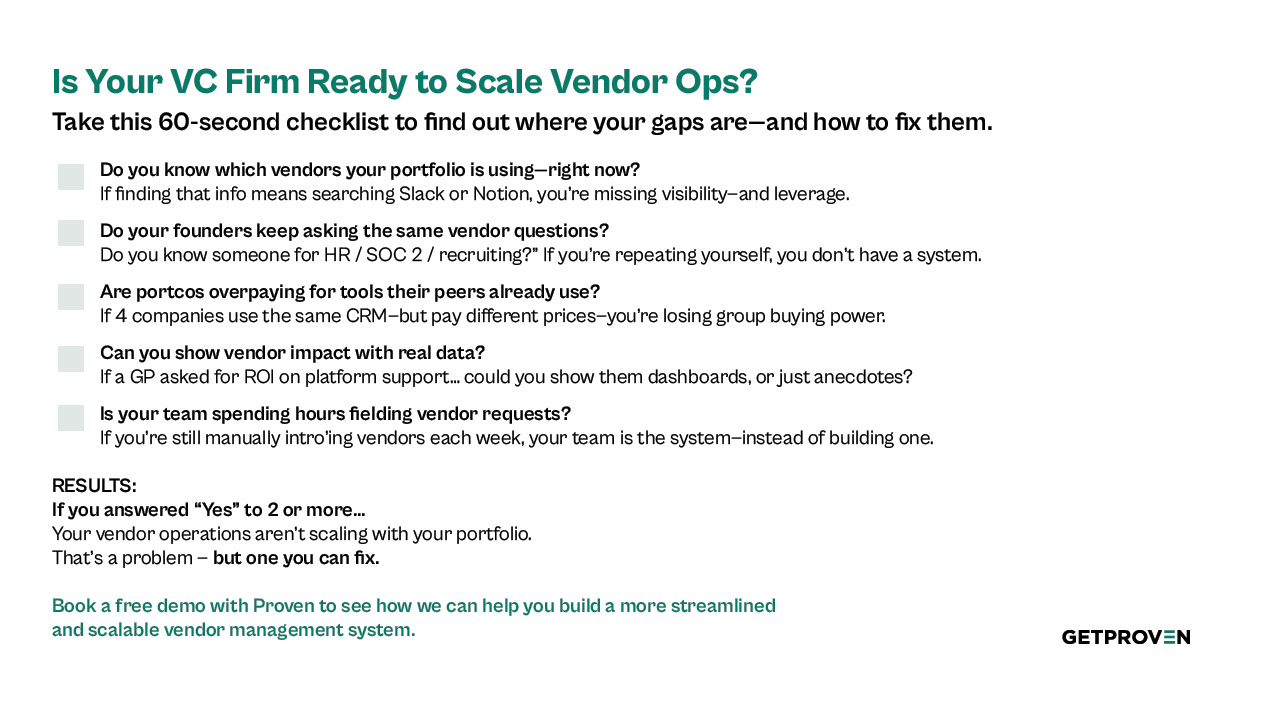
Is your VC firm ready for a vendor operations platform? (Self-Assessment Checklist)
Not sure if now’s the right time to invest in a vendor operations platform? Start here.
This 5-point checklist will help you assess how mature, scalable, and effective your current vendor management approach really is and whether it’s time to upgrade from reactive help to a system that scales.
How do you make the business case for vendor operations internally?
You already feel the inefficiencies; now you're starting to see the opportunity. So it’s time to bring your partners along. Here’s how top platform leaders frame the case clearly, strategically, and in the language venture capitalists listen to.
Lead with Outcomes, Not Tools
Don’t sell “software.” Sell leverage. Tell them “This isn’t about buying a tool. It’s about cutting burn, speeding execution, and proving platform ROI.”
Frame vendor ops in terms that matter at the fund level:
- Faster vendor selection = faster execution
- Shared discounts = reduced burn
- Tracked usage = operational reporting for LPs
Show the Cost of Doing Nothing
Start with what’s broken:
- We can’t see who’s using what.
- We field the same vendor asks every week.
- We’ve missed group savings across multiple portcos.
Then show what a platform unlocks:
- Real-time vendor maps
- Tracked redemptions and savings
- Founder ratings and feedback loops
Bonus: Use a simple ROI calculator to forecast potential savings.
Tie It to Fund-Level Outcomes
A vendor platform helps us deliver real value to founders and show it to LPs. It creates scalable structure, not one-off solutions. It sets us up for consistency across funds.
Start Small, Scale Fast
Ease friction by proposing a pilot:
- Roll out to 5–10 portcos
- Measure time saved, vendor adoption, and feedback
- Present results in the next ops or partner meeting
Don't pitch a platform. Propose a system that creates compounding value across the fund.
Conclusion
The most forward-thinking teams in the venture capital industry aren’t waiting for vendor chaos to sort itself out. Portfolio management is quickly becoming a game of building the right systems that scale for your founders.
Vendor operations may not be as top of mind as deal flow management or affect the investment process of your fund, but it is leverage, savings, and strategy wrapped into one. Done right, it can be your firm's competitive edge, even when stacked against what most alternative asset managers would consider more valuable.
Since your founders need speed and your GPs need proof. Your team needs a platform.
Try Proven for free or estimate how much your portfolio could be saving today.
Frequently asked questions


Browse more topics from this article
Heading 1
Heading 2
Heading 3
Heading 4
Heading 5
Heading 6
Lorem ipsum dolor sit amet, consectetur adipiscing elit, sed do eiusmod tempor incididunt ut labore et dolore magna aliqua. Ut enim ad minim veniam, quis nostrud exercitation ullamco laboris nisi ut aliquip ex ea commodo consequat. Duis aute irure dolor in reprehenderit in voluptate velit esse cillum dolore eu fugiat nulla pariatur.
Block quote
Ordered list
- Item 1
- Item 2
- Item 3
Unordered list
- Item A
- Item B
- Item C
Bold text
Emphasis
Superscript
Subscript
Heading 1
Heading 2
Heading 3
Heading 4
Heading 5
Heading 6
Lorem ipsum dolor sit amet, consectetur adipiscing elit, sed do eiusmod tempor incididunt ut labore et dolore magna aliqua. Ut enim ad minim veniam, quis nostrud exercitation ullamco laboris nisi ut aliquip ex ea commodo consequat. Duis aute irure dolor in reprehenderit in voluptate velit esse cillum dolore eu fugiat nulla pariatur.
Block quote
Ordered list
- Item 1
- Item 2
- Item 3
Unordered list
- Item A
- Item B
- Item C
Bold text
Emphasis
Superscript
Subscript
Heading 1
Heading 2
Heading 3
Heading 4
Heading 5
Heading 6
Lorem ipsum dolor sit amet, consectetur adipiscing elit, sed do eiusmod tempor incididunt ut labore et dolore magna aliqua. Ut enim ad minim veniam, quis nostrud exercitation ullamco laboris nisi ut aliquip ex ea commodo consequat. Duis aute irure dolor in reprehenderit in voluptate velit esse cillum dolore eu fugiat nulla pariatur.
Block quote
Ordered list
- Item 1
- Item 2
- Item 3
Unordered list
- Item A
- Item B
- Item C
Bold text
Emphasis
Superscript
Subscript
Heading 1
Heading 2
Heading 3
Heading 4
Heading 5
Heading 6
Lorem ipsum dolor sit amet, consectetur adipiscing elit, sed do eiusmod tempor incididunt ut labore et dolore magna aliqua. Ut enim ad minim veniam, quis nostrud exercitation ullamco laboris nisi ut aliquip ex ea commodo consequat. Duis aute irure dolor in reprehenderit in voluptate velit esse cillum dolore eu fugiat nulla pariatur.
Block quote
Ordered list
- Item 1
- Item 2
- Item 3
Unordered list
- Item A
- Item B
- Item C
Bold text
Emphasis
Superscript
Subscript
Heading 1
Heading 2
Heading 3
Heading 4
Heading 5
Heading 6
Lorem ipsum dolor sit amet, consectetur adipiscing elit, sed do eiusmod tempor incididunt ut labore et dolore magna aliqua. Ut enim ad minim veniam, quis nostrud exercitation ullamco laboris nisi ut aliquip ex ea commodo consequat. Duis aute irure dolor in reprehenderit in voluptate velit esse cillum dolore eu fugiat nulla pariatur.
Block quote
Ordered list
- Item 1
- Item 2
- Item 3
Unordered list
- Item A
- Item B
- Item C
Bold text
Emphasis
Superscript
Subscript




.png)